

100+ Compare and Contrast Essay Topics in Nursing: Best Compare and Contrast Essay Topics and Writing Tips for a Strong Nursing Essay
In nursing, the ability to critically examine similarities and differences between concepts, practices, and professional roles is essential for advancing both knowledge and clinical practice. A compare and contrast essay offers a structured framework to analyze two subjects systematically, highlighting their respective strengths, limitations, and applications within the field of nursing. These essays go beyond simple description, providing a method to evaluate theories, patient care strategies, nursing leadership approaches, and clinical practices through an analytical and evidence-based lens.
Exploring compare and contrast essay topics in nursing encourages a deeper understanding of the nursing profession and its diverse areas, from pediatric nursing to mental health nursing, from frontline registered nurse responsibilities to advanced practice roles such as nurse practitioner. By comparing approaches to patient care, leadership models, or nursing theories, these essays help clarify how different strategies influence patient outcomes, professional standards, and the delivery of safe, effective care in various care settings.
Additionally, contrast essays facilitate the integration of research topics, clinical experience, and evidence-based practice. They provide a structured way to analyze differences and overlaps in nursing practice, healthcare systems, and the implementation of nursing care protocols. This approach supports informed decision-making, strengthens the application of science in nursing, and enhances the understanding of how theoretical frameworks translate into practical interventions.
This article presents a comprehensive guide to compare and contrast nursing essays, detailing methods for selecting relevant topics, structuring essays effectively, and integrating scholarly research. By addressing the role of nursing in clinical practice, leadership, and education, and by highlighting actionable writing tips, it provides a resource for crafting well-organized, analytical, and insightful essays. Through careful examination of nursing theories, leadership models, and patient-centered practices, compare and contrast essay topics in nursing illuminate the complexity and depth of the world of nursing while fostering critical reflection on its evolving practices.
Understanding Compare and Contrast Essays in Nursing
What is a Compare and Contrast Essay and How Does it Apply to Nursing Practice?
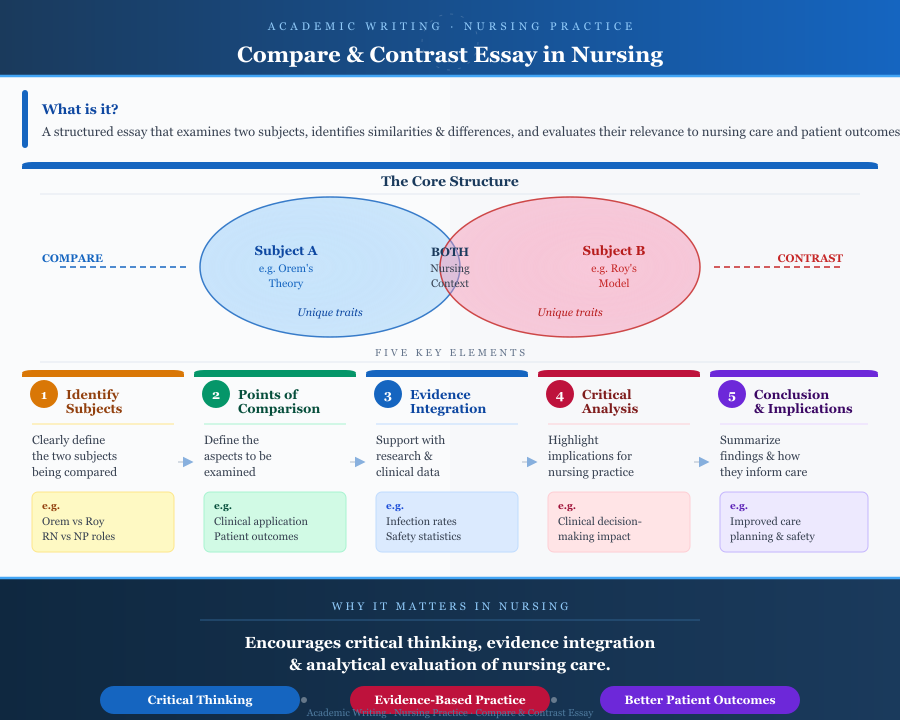
A compare and contrast essay is a structured form of writing that examines two subjects, identifies their similarities and differences, and evaluates their relevance, effectiveness, or impact. In the context of nursing practice, this type of essay is particularly valuable because it encourages critical thinking, evidence integration, and analytical evaluation of concepts that directly affect nursing care and patient outcomes.
Key elements of a compare and contrast essay in nursing practice include:
- Identification of Subjects: Clearly define the two subjects being compared. For instance:
- Comparing Orem’s Self-Care Deficit Nursing Theory with Roy’s Adaptation Model.
- Contrasting registered nurse roles with nurse practitioner roles in clinical practice.
- Establishing Points of Comparison: Determine the aspects on which the subjects will be compared, such as:
- Clinical application in patient care.
- Theoretical foundations guiding nursing practice.
- Influence on patient outcomes or care efficiency.
- Evidence Integration: Support comparisons with nursing research, scholarly articles, and clinical examples. For example, when comparing hand hygiene protocols in ICU vs. long-term care, reference infection rates, adherence statistics, and patient safety outcomes.
- Critical Analysis: Highlight the implications of similarities and differences for professional nursing, clinical decision-making, and healthcare systems. This is particularly important for contrast essays that evaluate alternative approaches in patient care or nursing education.
- Conclusion and Implications: Summarize the findings, emphasizing how understanding these comparisons improves nursing practice and informs decision-making in clinical practice and care planning.
Example:
A compare and contrast nursing essay might evaluate pediatric nursing vs. mental health nursing:
- Similarities: Both prioritize patient-centered care, communication, and safety.
- Differences: Pediatric nursing focuses on growth and development milestones, vaccinations, and family education; mental health nursing emphasizes behavioral assessment, psychosocial support, and crisis intervention.
Through this approach, a compare and contrast essay becomes a tool to strengthen analytical skills while demonstrating the applicability of theoretical knowledge to practice nursing.
Key Similarities and Differences in Nursing and Other Health Professions
Understanding the similarities and differences between nursing and other health professions is essential for analyzing the nursing profession in a broader healthcare system context.
Similarities include:
- Shared responsibilities in patient monitoring, documentation, and medication administration.
- Participation in evidence-based practice and adherence to ethical standards.
- Collaboration in interdisciplinary teams to optimize patient outcomes.
Differences include:
- Scope of Practice: Nurses provide holistic care, patient education, and ongoing support, whereas physicians primarily focus on diagnosis and treatment planning.
- Role in Decision-Making: Advanced practice nurses and nurse practitioners can manage patient care independently in many care settings, while allied health professionals often have more specialized functions.
- Focus Areas:
- Nursing emphasizes patient advocacy, continuity of care, and psychosocial support.
- Other health professions may emphasize diagnostics, technical procedures, or surgical interventions.
Example:
A contrast essay could explore nursing vs. physical therapy roles in rehabilitation:
- Nursing: Administers medications, monitors vital signs, ensures patient safety, and coordinates care.
- Physical therapy: Focuses on mobility, muscle function, and exercise-based interventions.
- Similarities: Both prioritize patient recovery and collaborate with the healthcare team.
This type of analysis highlights the unique role of nursing while showing how similarities and differences contribute to comprehensive patient care.
Evidence-Based Practice and Its Role in Compare and Contrast Nursing Essays
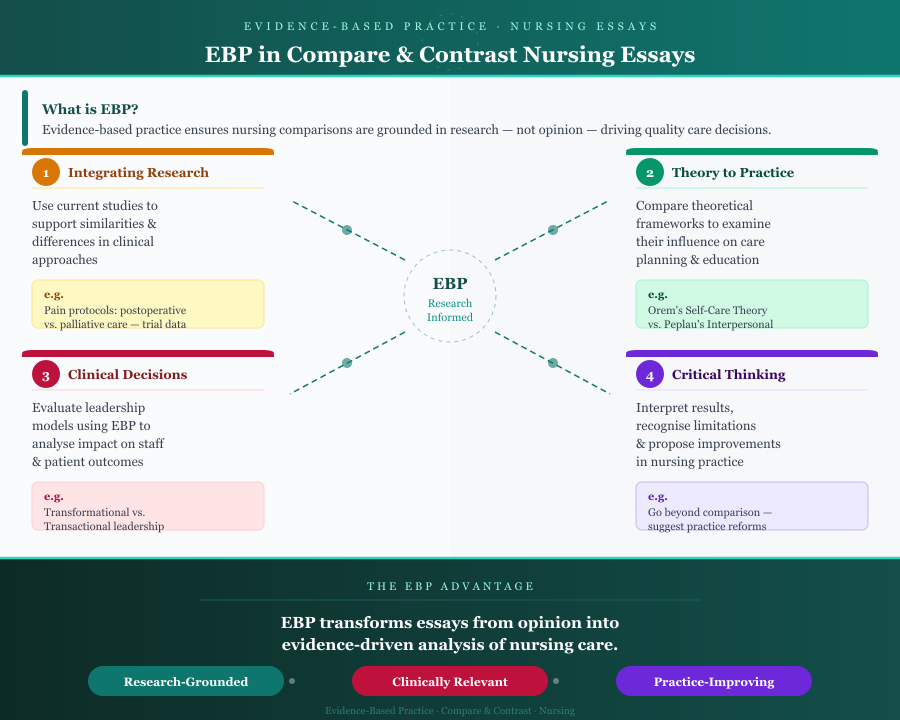
Evidence-based practice (EBP) is central to both nursing practice and the development of high-quality compare and contrast essays in nursing. Incorporating EBP ensures that comparisons are informed by research rather than opinion.
Key aspects include:
- Integrating Research into Analysis:
- Use current studies to support similarities and differences in clinical approaches, leadership models, or nursing theories.
- Example: Comparing the effectiveness of pain management protocols in postoperative vs. palliative care using clinical trial data.
- Linking Theory to Practice:
- Compare theoretical frameworks such as Orem’s Self-Care Theory and Peplau’s Interpersonal Relations Theory to see how they influence nursing care planning, patient education, and therapeutic interventions.
- Supporting Clinical Decision-Making:
- Essays can evaluate nursing leadership models, such as transformational vs. transactional leadership, using EBP to analyze impacts on staff performance and patient outcomes.
- Enhancing Critical Thinking:
- EBP allows writers to not only compare two subjects but also interpret results, recognize limitations, and propose improvements in practice nursing.
Example:
A compare and contrast nursing essay might examine the use of electronic handover tools versus bedside shift reporting:
- Evidence may show that electronic handovers improve documentation accuracy, while bedside reporting enhances patient engagement.
- An EBP-driven analysis enables a nuanced evaluation of both methods in improving patient care outcomes and nursing practice efficiency.
Incorporating evidence-based practice transforms a simple comparison into a rigorous, analytical, and professionally relevant discussion, illustrating how theory, research, and clinical application intersect in the world of nursing.
Selecting Strong Compare and Contrast Essay Topics in Nursing
How to Choose the Best Nursing Essay Topics for Compare and Contrast Assignments
Choosing an effective nursing essay topic is the foundation of a successful compare and contrast nursing essay. A well-selected topic ensures the essay is focused, researchable, and capable of producing meaningful insights into nursing practice and patient care.
Consider the following steps when selecting topics:
- Identify Areas of Interest in Nursing:
- Focus on aspects of the nursing profession that are relevant, current, and applicable to clinical practice or nursing education.
- Examples: pediatric nursing, mental health nursing, nursing leadership, or advanced practice roles.
- Ensure Scope and Feasibility:
- Choose topics that are neither too broad nor too narrow.
- Broad topics (e.g., “nursing and healthcare systems”) may lack depth, while overly specific topics (e.g., “comparing two wound care products in a single hospital unit”) may have limited research material.
- Consider Availability of Evidence and Research:
- Opt for topics that allow integration of evidence-based practice and nursing research.
- Example: Comparing traditional bedside patient education versus digital patient education tools is viable because there is ample literature on outcomes, adherence, and patient satisfaction.
- Assess Relevance to Clinical and Academic Goals:
- Choose topics that demonstrate understanding of nursing theories, clinical reasoning, or professional development.
- Example: Contrasting Orem’s Self-Care Theory with Roy’s Adaptation Model provides insights into theory-based nursing care planning.
50 Research-Based Compare and Contrast Nursing Topics
Clinical Practice and Patient Care
- Postoperative pain management: opioid vs. non-opioid approaches
- Traditional bedside reporting vs. electronic handover systems
- Early mobility protocols vs. standard postoperative care
- Telehealth nursing vs. in-person follow-up in chronic disease management
- Standardized patient education vs. individualized teaching plans
- Acute care vs. long-term care interventions for infection control
- Nurse-led vs. physician-led patient rounds and their effect on patient outcomes
- Evidence-based fall prevention vs. routine safety measures
- Use of continuous vs. intermittent vital sign monitoring in critical care
- Patient-centered care vs. task-oriented care in hospital units
Nursing Leadership and Management
11. Transformational vs. transactional nursing leadership models
12. Autocratic vs. democratic leadership styles in clinical nursing teams
13. Nurse-led vs. physician-led care management in multidisciplinary units
14. Shared governance vs. hierarchical management structures
15. Leadership approaches in rural vs. urban healthcare facilities
Nursing Education and Training
16. Simulation-based training vs. traditional clinical rotations
17. Standardized testing vs. practical skill assessments in nursing programs
18. Problem-based learning vs. lecture-based teaching in nursing education
19. Interprofessional education vs. discipline-specific education in care outcomes
20. Online learning vs. in-person training for advanced nursing courses
Nursing Theories and Evidence-Based Practice
21. Orem’s Self-Care Theory vs. Roy’s Adaptation Model in care planning
22. Peplau’s Interpersonal Relations Theory vs. Watson’s Theory of Human Caring
23. Henderson’s Need Theory vs. Neuman’s Systems Model in patient assessment
24. Comparing implementation of evidence-based wound care vs. traditional wound care
25. Use of evidence-based nutrition protocols vs. standard dietary guidance in hospitalized patients
Specialty Nursing Areas
26. Pediatric nursing vs. adult medical-surgical nursing approaches
27. Mental health nursing vs. psychiatric-mental health advanced practice nursing
28. Oncology nursing vs. palliative care nursing approaches to symptom management
29. Critical care nursing vs. emergency nursing interventions
30. Neonatal intensive care vs. pediatric intensive care: patient outcomes and protocols
Nursing Informatics and Technology
31. Electronic health records (EHR) vs. paper-based documentation in clinical accuracy
32. Telehealth interventions vs. traditional follow-ups in patient adherence
33. Mobile health apps vs. in-person health education for chronic disease patients
34. Automated medication dispensing vs. manual medication administration
35. Clinical decision support systems vs. standard protocols for infection prevention
Nursing Research and Evidence Integration
36. Qualitative vs. quantitative research in evaluating patient satisfaction
37. Randomized controlled trials vs. cohort studies in nursing research
38. Single-site studies vs. multi-site studies in evaluating clinical interventions
39. Comparative effectiveness research vs. traditional experimental research in nursing practice
40. Evidence-based clinical guidelines vs. traditional protocols in patient care
Nursing Roles and Scope of Practice
41. Registered nurse vs. nurse practitioner in chronic disease management
42. Advanced practice nurse vs. clinical nurse specialist in specialty care outcomes
43. Staff nurse vs. charge nurse in quality improvement initiatives
44. Nurse educator vs. clinical nurse mentor in student competency development
45. Community health nurse vs. hospital nurse in patient education and follow-up
Patient Safety and Quality of Care
46. Hand hygiene protocols vs. isolation precautions in infection prevention
47. Rapid response teams vs. standard emergency response in inpatient care
48. Checklists vs. verbal briefings in surgical safety and outcomes
49. Evidence-based medication reconciliation vs. standard procedures in reducing errors
50. Standardized pain assessment tools vs. patient self-reporting in symptom management
50 Argumentative and Evidence-Based Essay Ideas
Clinical Practice and Patient Care
- Should patient-centered care take priority over task-oriented care in hospitals?
- Is telehealth as effective as in-person care for chronic disease management?
- Should evidence-based protocols replace traditional nursing interventions entirely?
- Are standardized patient education programs superior to individualized teaching plans?
- Does nurse-led care improve patient outcomes compared to physician-led interventions?
- Should hospitals adopt electronic handover systems over bedside reporting?
- Are rapid response teams more effective than traditional emergency response in patient safety?
- Is continuous vital sign monitoring better than intermittent monitoring in critical care units?
- Should postoperative pain management rely more on non-opioid interventions?
- Does early mobility improve recovery rates better than standard care protocols?
Nursing Leadership and Management
11. Is transformational leadership more effective than transactional leadership in nursing?
12. Should shared governance be implemented in all hospital units?
13. Do autocratic nursing leadership styles hinder staff performance compared to democratic styles?
14. Should nurse managers have equal decision-making authority as physicians in care planning?
15. Does advanced practice nursing leadership improve patient outcomes in critical care settings?
Nursing Education and Training
16. Is simulation-based training more effective than traditional clinical rotations?
17. Should nursing schools emphasize interprofessional education over discipline-specific education?
18. Does online learning provide comparable competency outcomes as in-person training?
19. Are problem-based learning methods more effective than lecture-based teaching in nursing programs?
20. Should standardized testing replace practical skill assessments in nursing education?
Nursing Theories and Evidence-Based Practice
21. Is Orem’s Self-Care Theory more applicable in clinical practice than Roy’s Adaptation Model?
22. Should Peplau’s Interpersonal Relations Theory guide patient care more than Watson’s Theory of Human Caring?
23. Is Henderson’s Need Theory more effective than Neuman’s Systems Model in acute care?
24. Should evidence-based wound care protocols replace traditional wound care entirely?
25. Are structured nursing assessments better guided by theory than clinical intuition alone?
Specialty Nursing Areas
26. Is pediatric nursing more demanding than adult medical-surgical nursing?
27. Should mental health nursing be integrated into general nursing education?
28. Are oncology nursing interventions more evidence-based than palliative care practices?
29. Should critical care nursing protocols differ significantly from emergency nursing practices?
30. Is neonatal intensive care more research-driven than pediatric intensive care?
Nursing Informatics and Technology
31. Should electronic health records replace all paper-based documentation in nursing?
32. Are mobile health applications as effective as traditional health education for patients?
33. Should telehealth become a standard part of community nursing care?
34. Are automated medication dispensing systems safer than manual medication administration?
35. Should clinical decision support systems guide all nursing interventions?
Nursing Roles and Scope of Practice
36. Should nurse practitioners have full prescribing authority compared to registered nurses?
37. Are advanced practice nurses more effective than clinical nurse specialists in specialty care?
38. Should staff nurses be empowered to make independent care decisions in hospital units?
39. Is the role of community health nurses undervalued compared to hospital nurses?
40. Should nurse educators focus more on clinical training than classroom instruction?
Patient Safety and Quality of Care
41. Are evidence-based hand hygiene protocols superior to standard precautions?
42. Should checklists replace verbal briefings in surgical safety?
43. Are standardized pain assessment tools better than patient self-reporting methods?
44. Should medication reconciliation be entirely evidence-based to prevent errors?
45. Do evidence-based fall prevention strategies reduce patient injuries more than routine measures?
Healthcare Policy and Ethics
46. Should nurses have a say in hospital policy-making compared to physicians?
47. Is mandatory continuing education more beneficial than optional professional development?
48. Should ethical guidelines in nursing be standardized across all healthcare institutions?
49. Is patient advocacy more effectively performed by advanced practice nurses than staff nurses?
50. Should nurses take a more active role in shaping national healthcare policies?
Structuring and Writing a Compare and Contrast Nursing Essay
Understanding the Compare and Contrast Essay Structure for Nursing Students
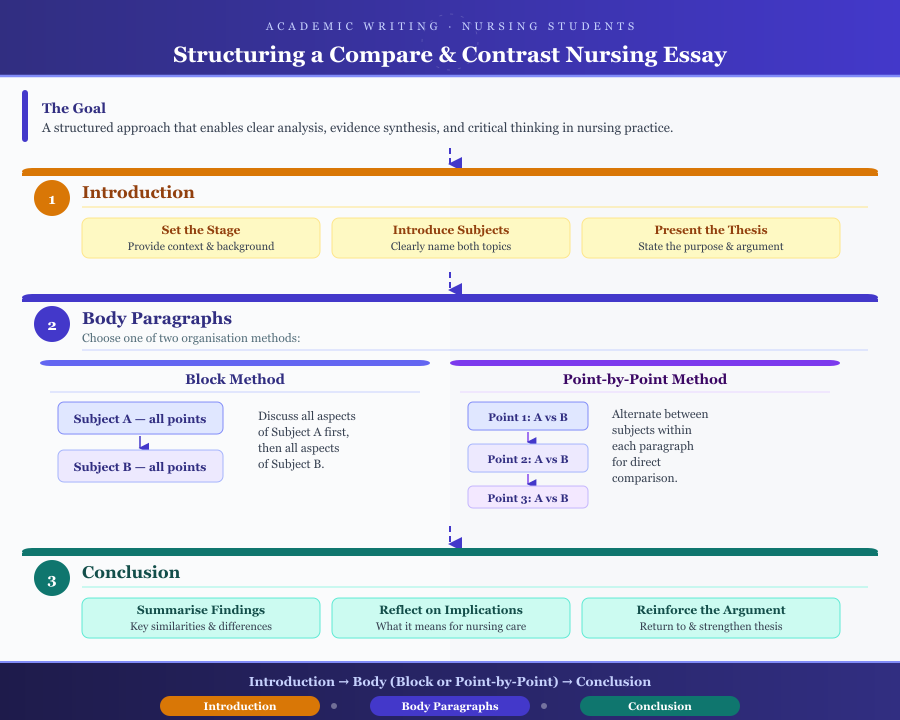
A well-organized compare and contrast nursing essay requires a structured approach that allows clear analysis of similarities and differences between two subjects. The standard essay structure provides a framework for presenting evidence, synthesizing information, and demonstrating critical thinking in nursing practice and patient care.
Key components of the structure include:
- Introduction: Sets the stage for the essay, introduces the two subjects, and presents a clear thesis.
- Body Paragraphs:
- Typically organized either by subject-by-subject (block method) or point-by-point method.
- Block method: Discuss all aspects of the first subject, then all aspects of the second.
- Point-by-point method: Alternate between subjects within each paragraph to compare specific points directly.
- Conclusion: Summarizes the key similarities and differences, reflects on the implications for nursing practice, and reinforces the main argument or findings.
Example of Structure Application:
- Comparing Orem’s Self-Care Theory vs. Roy’s Adaptation Model:
- Block Method: Discuss Orem’s emphasis on patient independence first, then discuss Roy’s adaptation-focused approach.
- Point-by-Point Method: Compare assessment strategies, care planning, and patient outcomes across both theories within the same paragraphs.
Using this structured approach ensures clarity in writing, logical progression of ideas, and effective integration of evidence-based practice.
Writing an Effective Introduction and Thesis Statement
The introduction is critical for engaging readers and establishing the purpose of the essay. In a compare and contrast nursing essay, the introduction should:
- Introduce the Subjects: Clearly state the two nursing topics, theories, or practices being analyzed.
- Example: “This essay examines the similarities and differences between pediatric nursing and mental health nursing in terms of patient assessment, care planning, and family involvement.”
- Provide Context: Briefly explain why the comparison is relevant to nursing practice and patient outcomes.
- Present a Clear Thesis Statement: The thesis should reflect the focus of the comparison and indicate whether the essay will emphasize similarities, differences, or both.
- Example Thesis: “While both pediatric and mental health nursing prioritize patient-centered care and safety, pediatric nursing focuses more on developmental milestones and family education, whereas mental health nursing emphasizes psychosocial assessment and crisis intervention, demonstrating how specialized approaches shape clinical practice.”
A strong thesis provides direction for the essay, allowing each paragraph to connect directly to the main argument.
Tips for Writing Clear and Insightful Contrast Essays About Patient Care
Writing a high-quality contrast essay requires precision, clarity, and thoughtful integration of nursing research and evidence-based practice.
Best Practices Include:
- Define Points of Comparison Clearly:
- Focus on specific elements such as assessment techniques, patient education, care planning, and intervention strategies.
- Avoid vague statements like “Nursing care is different in every setting.” Instead, specify what aspects are being compared.
- Use Evidence to Support Claims:
- Reference peer-reviewed research, clinical guidelines, and case studies.
- Example: Comparing hand hygiene protocols in acute care vs. long-term care units with infection rate statistics.
- Maintain Objectivity:
- Present similarities and differences neutrally, avoiding biased language.
- Example: “Both registered nurses and nurse practitioners provide patient care, but nurse practitioners have expanded prescribing authority, which allows them to manage treatment plans independently.”
- Use Transitional Words for Clarity:
- Words like similarly, in contrast, whereas, however, and on the other hand help maintain flow and clarity.
- Incorporate Clinical Relevance:
- Tie comparisons to nursing practice, patient outcomes, and professional standards.
- Example: Discussing how differences in pediatric vs. adult nursing assessment strategies impact patient safety and care effectiveness.
Developing Arguments in Nursing Essays
Developing a coherent argument in a compare and contrast nursing essay requires analytical reasoning, structured evidence, and clear articulation of implications for clinical practice and nursing education.
Steps for Developing Arguments:
- Identify Key Similarities and Differences:
- Create a chart or outline listing the points of comparison for each subject.
- Example: Comparing evidence-based pain management protocols in postoperative vs. palliative care.
- Integrate Evidence-Based Practice:
- Support each claim with research studies, clinical guidelines, or statistical data.
- Example: Citing studies showing reduced postoperative pain using multimodal analgesia vs. traditional opioid-only approaches.
- Evaluate Implications:
- Discuss how the similarities and differences influence nursing practice, patient care, and healthcare outcomes.
- Example: Highlighting that personalized pain management strategies improve patient satisfaction and reduce complications.
- Anticipate Counterarguments:
- Address potential limitations or opposing perspectives.
- Example: “While simulation-based training improves skill acquisition, it may not fully replicate the complexity of real-world clinical environments.”
- Conclude Each Argument Effectively:
- Summarize how each comparison contributes to understanding the topic.
- Reinforce relevance to nursing care, leadership, or education.
Example:
- Comparing registered nurse vs. nurse practitioner roles in chronic disease management:
- Argument: Nurse practitioners’ advanced scope of practice allows for independent management of treatment plans, but registered nurses provide essential bedside monitoring and patient education.
- Evidence: Studies demonstrating improved adherence and patient outcomes in clinics led by nurse practitioners, while highlighting the complementary role of registered nurses.
Advanced Nursing Essay Topics and Comparative Paper Ideas
Compare and Contrast Nursing Leadership and Practice Models
Nursing leadership and practice models play a critical role in shaping patient care, staff performance, and overall healthcare outcomes. Comparing and contrasting these models in a nursing essay allows for a deep analysis of organizational dynamics and evidence-based approaches in clinical practice.
Common Nursing Leadership Models to Compare:
- Transformational vs. Transactional Leadership
- Transformational leadership focuses on inspiring and motivating staff, fostering innovation, and promoting professional growth.
- Transactional leadership emphasizes structure, rules, and rewards or penalties to achieve outcomes.
- Example: In a hospital setting, transformational leaders may implement mentorship programs for nursing students and staff, improving patient outcomes, whereas transactional leaders may ensure compliance with policies and documentation accuracy.
- Servant Leadership vs. Democratic Leadership
- Servant leadership prioritizes team well-being and patient-centered care, promoting collaboration.
- Democratic leadership encourages shared decision-making but may be slower in urgent clinical situations.
- Example: Servant leadership may improve nurse retention and job satisfaction, directly impacting clinical practice quality.
Practice Models to Compare:
- Primary Nursing vs. Team Nursing:
- Primary nursing assigns one nurse to oversee a patient’s care from admission to discharge.
- Team nursing divides responsibilities among a group of nurses.
- Example: Comparing these models reveals that primary nursing enhances accountability and patient education, while team nursing improves workflow efficiency in high-volume care settings.
Writing Tips for Leadership and Practice Model Essays:
- Highlight similarities and differences in structure, roles, and impact on nursing care.
- Use research-based evidence on patient outcomes, staff satisfaction, and care quality.
- Discuss the relevance of leadership style to advanced nursing practice, clinical decision-making, and healthcare system efficiency.
Linking Nursing Research to Clinical Practice
Integrating nursing research into clinical practice is a fundamental aspect of evidence-based nursing, and it provides fertile ground for compare and contrast essays. This connection demonstrates how research informs care delivery, policy implementation, and practice improvements.
Steps to Link Nursing Research to Clinical Practice:
- Identify Research Areas Relevant to Nursing Practice:
- Examples: pain management protocols, infection control strategies, telehealth interventions, or pediatric patient education.
- Compare Evidence-Based Interventions with Standard Practice:
- Example: Compare outcomes from implementing evidence-based fall prevention strategies versus traditional approaches in long-term care facilities.
- Evidence may show reduced fall rates, increased patient safety, and improved staff compliance with protocols.
- Discuss Implications for Patient Care:
- Linking research findings to real-world nursing practice demonstrates how nursing theories, clinical protocols, and leadership decisions converge to enhance patient outcomes.
- Integrate Quantitative and Qualitative Data:
- Use clinical trial results, cohort studies, and patient surveys to illustrate differences between interventions or care approaches.
Example:
- Compare telehealth management vs. in-person follow-up for chronic disease patients.
- Telehealth: Increases access, reduces hospital readmissions, and promotes self-management.
- In-person care: Allows physical assessments and stronger patient-provider rapport.
- An essay could argue how integrating nursing research findings supports decision-making on which approach to adopt in different care settings.
20 Topics Highlighting Similarities and Differences in Nursing Theories
Exploring nursing theories provides a strong foundation for compare and contrast essays, as theories guide clinical practice, patient care, and nursing education. Below are 20 research-based topics for comparative essays:
- Orem’s Self-Care Theory vs. Roy’s Adaptation Model
- Peplau’s Interpersonal Relations Theory vs. Watson’s Theory of Human Caring
- Henderson’s Need Theory vs. Neuman’s Systems Model
- King’s Goal Attainment Theory vs. Johnson’s Behavioral System Model
- Orlando’s Nursing Process Theory vs. Roy’s Adaptation Model
- Benner’s Novice to Expert Model vs. Patricia Benner’s Clinical Judgment Model
- Watson’s Theory of Human Caring vs. Swanson’s Theory of Caring
- Roy’s Adaptation Model vs. Levine’s Conservation Model
- Orem’s Self-Care Deficit Nursing Theory vs. Henderson’s Need Theory
- King’s Theory of Goal Attainment vs. Peplau’s Interpersonal Relations Theory
- Watson’s Human Caring vs. Orlando’s Nursing Process Theory
- Neuman’s Systems Model vs. Johnson’s Behavioral System Model
- Roy’s Adaptation Model vs. Neuman’s Systems Model: Impact on critical care nursing
- Henderson’s Need Theory vs. Swanson’s Theory of Caring: Holistic care perspectives
- Orem’s Self-Care Theory vs. King’s Goal Attainment Theory: Patient education focus
- Peplau’s Interpersonal Relations Theory vs. Orlando’s Nursing Process Theory: Nurse-patient communication
- Benner’s Novice to Expert Model vs. Swanson’s Theory of Caring: Competency and caring
- Watson’s Theory of Human Caring vs. Levine’s Conservation Model: Promoting patient wellness
- Neuman’s Systems Model vs. Roy’s Adaptation Model: Stress and adaptation in nursing care
- Henderson’s Need Theory vs. King’s Goal Attainment Theory: Role of patient independence
Approach for Essay Writing on Theories:
- Introduce both theories with background, origin, and scope of practice.
- Identify key similarities and differences in their application to nursing care, patient education, and clinical decision-making.
- Integrate evidence-based practice or research findings demonstrating real-world outcomes.
- Conclude by reflecting on which theory or combination provides optimal guidance for advanced nursing practice.
Example:
- Comparing Orem’s Self-Care Theory vs. Roy’s Adaptation Model in pediatric nursing:
- Orem: Focus on teaching self-care skills to children and families.
- Roy: Focus on adaptation strategies in response to illness or hospitalization.
- Similarity: Both theories emphasize patient-centered care.
- Difference: Orem prioritizes independence; Roy prioritizes adaptive coping.
Examples, Resources, and Writing Support
Best Compare and Contrast Essay Examples for Nursing Students
Examining high-quality compare and contrast essay examples allows for a deeper understanding of structure, analytical reasoning, and integration of evidence-based practice in nursing. Examples help highlight best practices for essay writing, clarify how to organize points of comparison, and provide models for integrating research findings.
Types of Effective Examples:
- Clinical Practice Essays:
- Example: “Comparing Evidence-Based Pain Management Protocols in Postoperative vs. Palliative Care Settings”
- Highlights differences in analgesic approaches, monitoring methods, and patient education strategies.
- Integrates nursing research and clinical outcomes.
- Learning Outcome: Demonstrates how to analyze interventions and assess impact on patient care.
- Example: “Comparing Evidence-Based Pain Management Protocols in Postoperative vs. Palliative Care Settings”
- Nursing Leadership Essays:
- Example: “Transformational vs. Transactional Nursing Leadership: Effects on Team Performance and Patient Outcomes”
- Evaluates leadership approaches, staff motivation, and quality of care metrics.
- Uses comparative frameworks to illustrate similarities and differences in leadership effectiveness.
- Learning Outcome: Shows how leadership theory can inform clinical practice and professional development.
- Example: “Transformational vs. Transactional Nursing Leadership: Effects on Team Performance and Patient Outcomes”
- Nursing Theories Essays:
- Example: “Orem’s Self-Care Theory vs. Roy’s Adaptation Model: Guiding Pediatric Nursing Interventions”
- Compares patient assessment, care planning, and teaching strategies.
- Integrates research evidence to support theory-based nursing interventions.
- Learning Outcome: Provides a template for writing theory-driven, comparative nursing essays.
- Example: “Orem’s Self-Care Theory vs. Roy’s Adaptation Model: Guiding Pediatric Nursing Interventions”
- Specialty Nursing Essays:
- Example: “Mental Health Nursing vs. Pediatric Nursing: Assessment Techniques and Patient Education”
- Discusses differences in communication strategies, psychosocial interventions, and family engagement.
- Highlights the importance of context-specific nursing care.
- Example: “Mental Health Nursing vs. Pediatric Nursing: Assessment Techniques and Patient Education”
Tips for Using Examples:
- Analyze the structure: introduction, thesis, body paragraphs, and conclusion.
- Note integration of research topics, clinical examples, and evidence-based practice.
- Observe how points of comparison are clearly articulated and supported with credible sources.
Using Writing Services and Academic Resources for Topic Refinement
Writing a strong compare and contrast nursing essay often requires refining the essay topic, organizing ideas, and ensuring proper integration of research-based evidence. Academic resources and writing services can support these objectives while maintaining educational integrity.
Ways Resources Can Help:
- Writing Centers and Tutors:
- Provide guidance on essay structure, thesis development, and integrating nursing research.
- Assist in clarifying points of comparison and ensuring alignment with nursing practice standards.
- Academic Databases and Journals:
- Access to peer-reviewed articles, case studies, and clinical guidelines enhances essay quality.
- Examples include Journal of Advanced Nursing, Nursing Research, and International Journal of Nursing Studies.
- Professional Writing Services (Ethical Use):
- Can provide editing support, feedback on clarity, or help refine essay ideas without writing the essay entirely.
- Supports development of comparative essays, especially when integrating complex nursing theories or evidence-based practice research.
- Guides and Templates:
- Structured essay templates or outlines illustrate introduction, thesis, body, and conclusion frameworks.
- Helpful for nursing students learning to balance descriptive content with analysis and research.
Example:
- A writing service may help a student refine the topic “Registered Nurse vs. Nurse Practitioner: Impact on Chronic Disease Management” into a focused essay that compares scope of practice, patient education strategies, and clinical outcomes, while integrating research studies and nursing leadership principles.
Creative and Unique Essay Titles for Nursing Students
- Registered Nurse vs. Nurse Practitioner: Comparative Roles in Chronic Disease Management
- Pediatric Nursing vs. Mental Health Nursing: Assessments, Interventions, and Patient Education
- Orem’s Self-Care Theory vs. Roy’s Adaptation Model: Application in Clinical Nursing Practice
- Transformational vs. Transactional Nursing Leadership: Impact on Staff Performance and Patient Outcomes
- Primary Nursing vs. Team Nursing: Comparing Workflow Efficiency and Patient Care Quality
- Simulation-Based Training vs. Clinical Rotations: Developing Competency in Nursing Practice
- Evidence-Based Pain Management vs. Traditional Approaches: Improving Postoperative Care
- Telehealth Nursing vs. In-Person Follow-Up: Evaluating Patient Engagement and Outcomes
- Benner’s Novice to Expert Model vs. Swanson’s Theory of Caring: Guiding Nursing Competency Development
- Acute Care Nursing vs. Long-Term Care Nursing: Comparing Patient Safety and Care Strategies
- Hand Hygiene Protocols vs. Isolation Precautions: Evidence-Based Strategies to Reduce Infection
- Community Health Nursing vs. Hospital-Based Nursing: Differences in Patient Education and Outreach
- Clinical Decision Support Systems vs. Standard Protocols: Enhancing Evidence-Based Nursing Practice
- Transformational Leadership vs. Servant Leadership: Effects on Nurse Retention and Job Satisfaction
- Orem’s Self-Care Theory vs. Henderson’s Need Theory: Guiding Patient Independence and Wellness
- Advanced Practice Nursing vs. Registered Nursing: Scope of Practice and Impact on Patient Outcomes
- Mental Health Nursing vs. Psychiatric Nursing: Comparing Therapeutic Communication Approaches
- Evidence-Based Fall Prevention vs. Routine Safety Measures: Reducing Patient Injuries in Hospitals
- Online Learning vs. In-Person Training: Developing Knowledge and Clinical Skills in Nursing Education
- Neonatal Intensive Care vs. Pediatric Intensive Care: Differences in Assessment, Intervention, and Family Engagement
Conclusion
Mastering compare and contrast essay topics in nursing requires more than just selecting subjects—it demands a deep understanding of nursing practice, patient care, and evidence-based approaches. Throughout this guide, we have explored how structured essay writing can illuminate similarities and differences in nursing theories, leadership models, clinical practices, and specialized care areas such as pediatric and mental health nursing.
By carefully choosing essay topics, linking nursing research to clinical practice, and developing clear, evidence-based arguments, writers can create essays that are both analytical and impactful. Integrating well-structured thesis statements, logical organization, and real-world examples ensures that essays are informative while reflecting the complexities of modern nursing practice.
Additionally, leveraging academic resources, writing support, and high-quality examples provides a foundation for refining essay topics and enhancing clarity. Creative and unique essay titles help guide focus, making complex nursing concepts accessible and engaging.
Ultimately, writing effective compare and contrast nursing essays strengthens critical thinking, reinforces understanding of nursing roles and theories, and bridges the gap between theory and practice. Whether analyzing leadership models, patient care strategies, or specialty nursing areas, these essays contribute to professional growth, promote evidence-based decision-making, and enhance overall patient outcomes.
A strong compare and contrast essay in nursing is not merely an academic requirement—it is a reflection of thoughtful analysis, a commitment to high-quality care, and a demonstration of the rigor and relevance of nursing as a profession.
Frequently Asked Questions
What are some good topics for a compare and contrast essay?
Good topics are ones that allow meaningful comparison of similarities and differences between two subjects. Examples include:
- Nursing theories: Orem’s Self-Care Theory vs. Roy’s Adaptation Model
- Nursing roles: Registered Nurse vs. Nurse Practitioner
- Care approaches: Evidence-Based Pain Management vs. Traditional Pain Management
- Leadership models: Transformational vs. Transactional Nursing Leadership
What are some good research topics for nursing?
Effective nursing research topics focus on clinical practice, patient outcomes, or healthcare improvements. Examples:
- The impact of telehealth on chronic disease management
- Infection control strategies in acute care vs. long-term care
- Comparing primary nursing vs. team nursing on patient satisfaction
- Evaluating evidence-based interventions for pediatric pain management
How to write an essay about nursing?
To write a nursing essay:
- Choose a focused topic related to practice, theory, or research.
- Conduct research using scholarly articles, case studies, and evidence-based guidelines.
- Create an outline: Introduction, body (organized by point-by-point or block method), and conclusion.
- Write a clear thesis statement and support it with evidence.
- Use professional language, cite sources accurately, and link discussions to nursing practice and patient care.
What are the best topics for essays?
The best essay topics are relevant, specific, and researchable. Examples for nursing include:
- Comparing nursing theories in clinical application
- Evaluating nursing leadership styles and their impact on patient care
- Differences in pediatric vs. adult nursing interventions
- Evidence-based vs. traditional nursing practices in wound care
These topics and approaches help ensure that essays are analytical, evidence-based, and clinically relevant.
