

300+ Best Health Essay Topics to Write About — essay topic ideas for medical research and public health
Selecting an appropriate essay topic is a foundational step in academic writing for public health and nursing students, as it shapes the depth, direction, and quality of the entire assignment. In disciplines that engage directly with population needs and clinical realities, the choice of a health topic is not merely an academic exercise; it reflects an understanding of real-world challenges that influence care delivery, prevention strategies, and system-level decision-making. A well-chosen health essay topic allows students to connect theory with practice, encouraging critical thinking while reinforcing the principles that underpin effective nursing and population-based care.
Public health and nursing education are grounded in inquiry, evidence, and application. Whether a student is preparing a short reflective paper or a more extensive research paper, the ability to identify meaningful topics to write about is essential. These topics often emerge from pressing public health concerns, evolving clinical standards, or observed gaps in care. In this context, academic writing becomes a structured way to explore health outcomes, examine contributing factors, and engage with existing evidence in a manner that is both analytical and ethically grounded.
As students progress in their training, they are increasingly expected to frame their work around a clear research topic that aligns with course objectives and scholarly expectations. This process requires more than selecting an area of interest; it involves evaluating scope, relevance, and feasibility while ensuring the topic supports rigorous analysis. Exploring health topics to write about through a critical lens helps students develop skills in literature appraisal, argument construction, and synthesis—competencies that are central to both nursing practice and public health scholarship.
This article provides a structured exploration of essay topic ideas suited to public health and nursing students, guiding readers through the process of identifying, refining, and developing topics that are academically sound and practically relevant. By situating topic selection within the broader context of education, practice, and research, the discussion emphasizes thoughtful inquiry over trend-driven choices, supporting students as they build a strong foundation for scholarly writing and professional growth.
How do I choose the best health essay topic or research topic for public health?
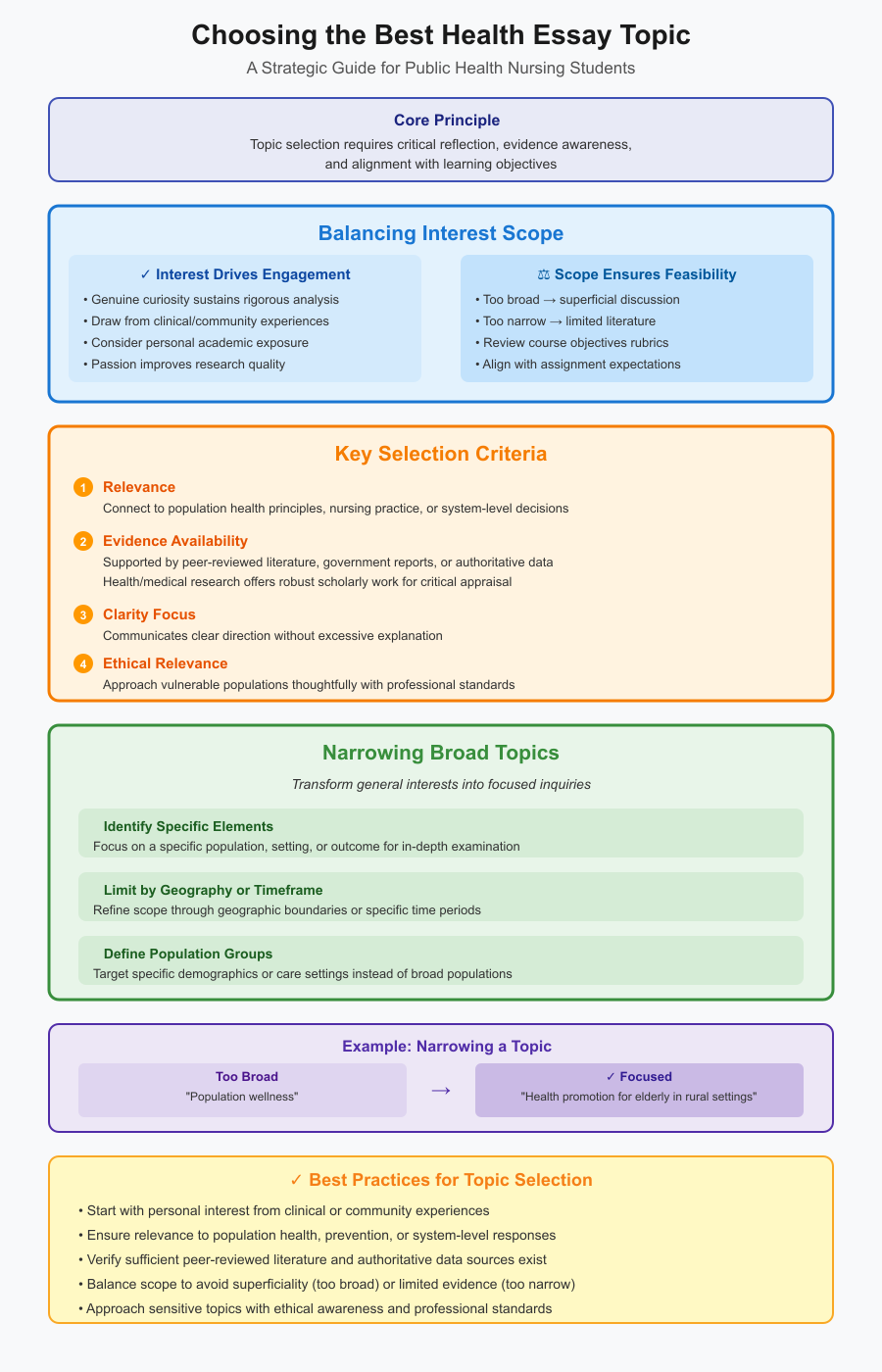
Choosing a meaningful topic in public health is a deliberate academic process that requires critical reflection, evidence awareness, and alignment with learning objectives. For nursing and public health students, topic selection is closely tied to understanding population needs, prevention strategies, and system-level responses to health problems. A carefully selected topic not only supports strong academic performance but also strengthens a student’s ability to analyze real-world health challenges through a scholarly lens.
How do I choose a public health topic that fits my interests and research paper scope?
Interest plays a central role in sustaining engagement throughout the writing process. Students are more likely to produce rigorous analysis when they are genuinely curious about the subject matter. For instance, exposure to community health settings may spark interest in population-level interventions, while clinical placements often raise questions related to health conditions, prevention, or access to care. These lived academic or clinical experiences provide a practical foundation for topic selection.
However, interest must be balanced against the scope of the assignment. A topic that is too broad may lead to superficial discussion, while one that is overly narrow can limit access to relevant literature. Reviewing course objectives and grading rubrics helps determine whether the assignment emphasizes analysis, comparison, or application of evidence. Aligning personal interest with assignment expectations ensures that the selected topic remains both engaging and feasible.
What criteria should I use to choose a health topic or essay topic idea?
Several criteria can guide students toward a strong and academically sound choice. Relevance is essential—the topic should clearly connect to population health principles, nursing practice, or system-level decision-making. Topics addressing public health issues such as prevention strategies, care delivery models, or population risk factors often provide strong analytical potential.
Availability of credible evidence is another key consideration. A viable topic should be supported by peer-reviewed literature, government reports, or authoritative public health data sources. For example, topics linked to health research or medical research tend to offer a robust body of scholarly work suitable for critical appraisal. Students should also consider clarity and focus, ensuring the topic communicates a clear direction without requiring excessive explanation.
Ethical relevance is equally important. Topics involving vulnerable populations or sensitive issues should be approached thoughtfully, with attention to professional standards and ethical principles. Selecting a topic that allows respectful, evidence-based discussion supports both academic integrity and professional development.
How can I narrow broad health topics to a focused research topic or research paper topic?
Many students begin with broad interests, such as prevention, wellness, or system reform, which can be difficult to address effectively in a single paper. Narrowing a topic involves identifying a specific population, setting, or outcome that can be examined in depth. For example, rather than addressing population wellness broadly, a student might focus on health promotion strategies within a defined demographic or care setting.
Limiting the scope by geography, timeframe, or population group can further refine the focus. This approach helps transform general interests into focused inquiries that support structured analysis and coherent argument development. Narrowing also improves alignment with available evidence, making it easier to synthesize findings and draw meaningful conclusions.
What are strong public health essay topics and public health issues to write about?
I. Population and Community-Focused Topics (1–40)
- Community-based disease prevention strategies
- Maternal and child health interventions in low-resource settings
- Adolescent health education programs
- Community vaccination uptake and barriers
- Rural–urban differences in healthcare access
- Community-led sanitation initiatives
- Nutrition education in underserved populations
- School-based health screening programs
- Community responses to infectious disease outbreaks
- Primary care access in marginalized communities
- Role of community health workers in prevention
- Faith-based organizations in health outreach
- Community engagement in health planning
- Preventive care utilization among older adults
- Cultural competence in community nursing
- Community resilience during public health emergencies
- Housing instability and population health
- Food insecurity and community nutrition outcomes
- Violence prevention initiatives at the community level
- Community mental health support models
- Migrant health needs and service delivery
- Health literacy programs in local communities
- Water safety and community health protection
- Urbanization and community disease patterns
- Community approaches to chronic disease management
- Role of local leadership in health promotion
- Indigenous community health initiatives
- Community-based rehabilitation services
- Disaster preparedness at the community level
- Social support networks and recovery outcomes
- Preventive screening uptake in community clinics
- Environmental exposures in residential areas
- Community nutrition policies and outcomes
- Access to reproductive health services
- Youth engagement in health advocacy
- Community health assessment models
- Prevention of substance misuse at community level
- Community-based palliative care
- Informal caregiving and community health
- Community partnerships in disease prevention
II. Global and Population Health Topics (41–80)
- Infectious disease surveillance systems
- Global responses to pandemics
- Health system strengthening in low-income countries
- Vaccine equity across regions
- Cross-border disease transmission challenges
- Global maternal mortality reduction strategies
- Climate change and population health risks
- Nutrition transitions in developing countries
- Global burden of chronic diseases
- Refugee health challenges
- International health regulations and compliance
- Antimicrobial resistance as a global threat
- Workforce shortages in global nursing
- Waterborne disease prevention worldwide
- Global childhood immunization programs
- Health financing models across countries
- International disaster response coordination
- Global tobacco control initiatives
- Nutrition supplementation programs
- Global strategies for HIV prevention
- Health workforce migration impacts
- Global injury prevention strategies
- Digital health innovations in low-resource settings
- Gender inequality and population health outcomes
- Global aging population challenges
- Universal health coverage initiatives
- Global surveillance of emerging infections
- Nutrition policies and food security
- Global mental health service gaps
- Urbanization trends and global health risks
- Cross-cultural nursing practice challenges
- Health diplomacy and international cooperation
- Global maternal nutrition programs
- Infectious disease elimination campaigns
- Global vaccination misinformation
- Environmental degradation and global health
- Health technology transfer to developing regions
- Global emergency preparedness
- Migration and cross-border healthcare delivery
- Global partnerships in disease prevention
III. Environmental and Occupational Health Topics (81–120)
- Air pollution and respiratory disease
- Occupational exposure to hazardous chemicals
- Workplace injury prevention strategies
- Noise pollution and worker health
- Environmental risk assessment models
- Water contamination and disease prevention
- Waste management and public safety
- Climate-related occupational hazards
- Pesticide exposure in agricultural workers
- Heat stress in outdoor occupations
- Workplace ergonomics and musculoskeletal disorders
- Environmental justice and exposure disparities
- Industrial pollution and population health
- Occupational stress and burnout
- Workplace safety regulations effectiveness
- Indoor air quality and health outcomes
- Environmental monitoring and disease prevention
- Occupational health nursing roles
- Construction site injury prevention
- Environmental toxins and childhood development
- Occupational health surveillance systems
- Green spaces and population well-being
- Waste disposal practices and infection control
- Occupational health education programs
- Environmental noise and cardiovascular risk
- Occupational hazards in healthcare workers
- Environmental exposure assessment tools
- Workplace mental health promotion
- Agricultural safety interventions
- Climate change adaptation in workplaces
- Environmental health risk communication
- Occupational disease reporting systems
- Chemical safety regulations
- Environmental health policy evaluation
- Occupational health program effectiveness
- Urban pollution mitigation strategies
- Worker protection legislation
- Environmental disaster response planning
- Occupational injury surveillance
- Sustainable workplaces and health
IV. Mental and Behavioral Health Topics (121–170)
- Community-based mental health care models
- Early detection of depression in primary care
- Mental health stigma reduction strategies
- Adolescent anxiety prevention programs
- Workplace mental health support initiatives
- Integration of mental health into primary care
- Substance use prevention in youth
- Suicide prevention strategies
- Mental health screening in schools
- Trauma-informed care in nursing
- Psychological impact of pandemics
- Stress management interventions for nurses
- Mental health literacy programs
- Digital mental health interventions
- Community crisis intervention services
- Post-traumatic stress management approaches
- Family involvement in mental health care
- Mental health promotion in universities
- Access to counseling services
- Cultural perspectives on mental illness
- Mental health policy implementation
- Peer support programs effectiveness
- Substance misuse treatment models
- Mental health care for older adults
- Workplace stress and coping mechanisms
- Community resilience and psychological recovery
- Screening tools for common mental disorders
- Burnout prevention in nursing
- Child and adolescent mental health services
- Mental health education in schools
- Psychological first aid in emergencies
- Community-based addiction recovery
- Mental health service delivery gaps
- Behavioral interventions for stress reduction
- Mental well-being promotion strategies
- Social support and mental health outcomes
- Access disparities in mental health care
- Digital platforms for mental health support
- Workplace counseling programs
- Prevention of substance-related harm
- Mental health advocacy initiatives
- Psychological effects of chronic illness
- Nurse-led mental health interventions
- Community outreach for mental health awareness
- Emotional resilience training
- Mental health screening in primary care
- Crisis hotline effectiveness
- Mental health integration in community clinics
- Youth mental health promotion programs
- Psychological impacts of social isolation
V. Health Systems, Policy, and Ethics Topics (171–230)
- Health policy development processes
- Financing models for healthcare systems
- Ethical challenges in public health decision-making
- Resource allocation during health emergencies
- Universal health coverage implementation
- Health workforce planning strategies
- Role of nurses in policy advocacy
- Equity in healthcare delivery
- Regulation of healthcare quality
- Health system responses to aging populations
- Ethical issues in disease surveillance
- Health policy evaluation methods
- Governance structures in health systems
- Public–private partnerships in healthcare
- Ethical implications of mandatory vaccination
- Health insurance coverage disparities
- Nursing leadership in health reform
- Accountability in healthcare institutions
- Policy responses to workforce shortages
- Ethical considerations in health data use
- Health system resilience planning
- Regulation of emerging medical technologies
- Policy approaches to chronic disease prevention
- Health sector corruption and accountability
- Ethics of rationing care
- Policy responses to antimicrobial resistance
- Integration of primary and secondary care
- Health policy communication strategies
- Legal frameworks for public health protection
- Ethical challenges in outbreak management
- Health policy implementation barriers
- Governance of digital health systems
- Policy-driven quality improvement initiatives
- Ethics of end-of-life care
- Health workforce retention policies
- Regulation of pharmaceutical pricing
- Health policy and population outcomes
- Ethical dilemmas in nursing practice
- Health system decentralization impacts
- Patient rights and policy enforcement
- Ethical oversight in medical research
- Policy strategies for health equity
- Regulation of healthcare professionals
- Health system preparedness for disasters
- Ethics of screening programs
- Policy approaches to mental health services
- Health policy impact evaluation
- Ethical issues in resource-limited settings
- Governance of health information systems
- Policy responses to noncommunicable diseases
- Ethical challenges in vaccination campaigns
- Health policy and access to care
- Regulation of clinical practice standards
- Ethical implications of telehealth
- Health system performance measurement
- Policy strategies for workforce training
- Ethics of community-based interventions
- Health policy and service integration
- Regulatory approaches to patient safety
- Ethical decision-making frameworks in nursing
VI. Nursing Practice, Education, and Innovation Topics (231–300)
- Evidence-based nursing interventions
- Patient safety initiatives in nursing care
- Clinical decision-making in nursing practice
- Nursing roles in disease prevention
- Use of technology in nursing education
- Interprofessional collaboration in healthcare
- Nursing care models for chronic illness
- Simulation-based nursing training
- Leadership development in nursing
- Quality improvement initiatives in nursing
- Nursing contributions to population health
- Infection prevention practices in nursing
- Ethical challenges in bedside nursing
- Nursing workload and care quality
- Patient-centered care models
- Nursing education curriculum development
- Innovations in nursing practice
- Nurse-led health education programs
- Clinical documentation and care outcomes
- Nursing interventions for vulnerable populations
- Professional identity formation in nursing
- Nursing informatics applications
- Transition to practice challenges for new nurses
- Cultural competence in nursing care
- Nursing responses to public health emergencies
- Continuing education and nursing competence
- Nursing advocacy for patient safety
- Evidence translation into nursing practice
- Nursing leadership in healthcare teams
- Clinical mentorship in nursing education
- Nursing roles in community outreach
- Quality assurance in nursing practice
- Nursing strategies for chronic disease management
- Ethical reasoning in nursing education
- Nursing interventions for health promotion
- Clinical innovation adoption in nursing
- Nursing contributions to health system resilience
- Patient education strategies in nursing
- Nursing workforce sustainability
- Professional development models in nursing
- Nursing perspectives on emerging technologies
- Care coordination and nursing practice
- Nursing leadership during health crises
- Patient advocacy roles of nurses
- Nursing competencies for population-based care
- Clinical governance in nursing
- Nursing engagement in prevention programs
- Technology-enhanced patient monitoring
- Nursing research utilization in practice
- Nursing strategies for improving care quality
- Professional ethics in nursing
- Nursing roles in policy implementation
- Clinical reasoning skill development
- Nursing education and workforce readiness
- Nursing practice standards evaluation
- Innovations in patient-centered nursing care
- Nursing leadership in quality improvement
- Nursing roles in interdisciplinary teams
- Patient safety culture in nursing units
- Nursing contributions to healthcare innovation
- Clinical practice guidelines in nursing
- Nursing education and competency assessment
- Nursing roles in chronic care coordination
- Ethical leadership in nursing practice
- Nursing strategies for improving outcomes
- Nursing involvement in health planning
- Evidence-informed nursing education
- Nursing responses to system-level challenges
- Nursing-led service delivery models
- Future directions in nursing practice
Which health research topics and medical research ideas are best for students?
Selecting appropriate health research topics is a critical step for undergraduate and nursing students because it determines not only the academic quality of an assignment but also its feasibility within limited time, resources, and methodological training. The most suitable topics allow students to engage meaningfully with evidence, apply foundational research skills, and draw clear connections between theory and real-world practice. In general, student-friendly topics focus on observable problems, well-documented interventions, or clearly defined populations, making them easier to analyze using existing literature rather than primary data collection.
Effective medical research ideas for students often emerge from coursework, clinical exposure, or widely recognized health concerns. Topics related to prevention, safety, and population-level risks are particularly appropriate because they are supported by a strong body of peer-reviewed evidence and authoritative reports. For example, examining injury prevention strategies in workplace settings or studying the health effects of environmental exposures allows students to work with established frameworks while developing analytical depth.
What medical research topics are feasible for undergraduate or nursing students?
Feasibility is one of the most important considerations when choosing a research topic. Undergraduate and nursing students typically benefit from topics that rely on secondary data, literature reviews, or policy analysis rather than complex experimental designs. Topics grounded in education, prevention, and care delivery models are especially suitable because they align with nursing competencies and public health learning outcomes.
For instance, exploring how safety protocols reduce workplace injuries in healthcare settings is manageable because it draws on occupational guidelines, surveillance reports, and published studies. Similarly, examining community exposure to environmental risks such as air or water pollution allows students to synthesize findings from epidemiological studies and public health reports. These approaches help students meet academic expectations without exceeding practical limitations.
How can I turn a health research topic into a manageable research paper or project?
Transforming a broad idea into a structured research paper requires careful refinement. Students should begin by clearly defining the population, setting, and outcome of interest. Narrowing the focus helps avoid overly descriptive work and supports critical analysis. For example, instead of broadly addressing workplace safety, a student might focus on injury prevention strategies among healthcare workers in acute care settings.
Developing a clear research question early in the process also improves manageability. A focused question guides literature selection, strengthens argument structure, and ensures coherence throughout the paper. Using established models or frameworks from health research further supports organization and analytical rigor, allowing students to compare findings, identify trends, and discuss implications effectively.
What are top research paper topics in occupational health and environmental health?
Topics in occupational health and environmental health are particularly well suited for student research because they address measurable risks and well-defined exposure pathways. Common areas of focus include workplace injury prevention, exposure to hazardous substances, and the effectiveness of safety regulations. These topics are supported by extensive data from regulatory agencies and peer-reviewed studies, making them accessible for academic analysis.
For example, a student might examine how ergonomic interventions reduce musculoskeletal injuries among nurses or analyze the health effects of prolonged exposure to industrial pollutants in urban environments. Such topics lend themselves to structured discussion, allowing students to evaluate existing evidence, discuss implications for practice, and suggest areas for future improvement. By selecting focused, evidence-supported topics within these fields, students can produce rigorous, well-organized research papers that demonstrate both academic competence and practical relevance.

What are compelling mental health essay topics and interesting health topics to write?
Selecting compelling mental health essay topics and interesting health topics to write requires careful consideration of relevance, feasibility, and potential impact on both individual and population well-being. Mental health topics are especially significant in nursing and public health education because they integrate clinical understanding with broader social, environmental, and policy determinants, allowing students to develop analytical, evidence-based arguments that are directly applicable to practice.
Compelling topics often revolve around observable challenges or pressing concerns that affect individuals, communities, and healthcare systems. For example, examining the mental health impact of pandemic-related social isolation provides opportunities to explore psychological stressors, coping mechanisms, and systemic interventions. Similarly, studying workplace burnout among healthcare professionals links mental well-being with health and wellness, workforce sustainability, and patient safety, making it a topic that is simultaneously practical, relevant, and researchable.
Which mental health topics address health and well-being, and make strong essay topics?
Strong mental health topics for essay writing are those that directly address factors influencing overall health and well-being. These topics allow students to explore how psychological states interact with physical health, social functioning, and quality of life. For instance, a student might examine the role of mindfulness-based interventions in reducing anxiety and depression among adolescents, illustrating how mental well-being contributes to resilience and long-term health outcomes.
Other compelling topics include:
- The relationship between chronic illness and depression in older adults
- The effectiveness of cognitive-behavioral therapy in managing stress in nursing students
- Community-based interventions to reduce suicide risk in vulnerable populations
Such topics allow students to synthesize findings from health research and medical research, demonstrating how interventions targeting mental health can influence broader health outcomes. By focusing on prevention, resilience, and evidence-based interventions, these essay topics provide meaningful links between clinical practice and public health objectives.
What interesting health topics to write about cover determinants of health and personal health?
Another effective approach is to examine determinants of health and their influence on personal health. These topics highlight the interplay between individual behaviors, social factors, and environmental conditions. For example:
- How socioeconomic status impacts adolescent mental well-being
- The effects of urban air pollution on respiratory health and stress levels
- Nutritional access and its relationship to cognitive performance in school-aged children
These interesting health topics are valuable for essay writing because they encourage students to explore complex causal pathways and disparities. For instance, analyzing how social determinants of health such as housing, education, and employment influence mental health outcomes provides a robust framework for discussion and allows for critical evaluation of both systemic and individual-level interventions. By integrating these factors, students can produce essays that reflect both analytical depth and practical relevance.
How can I develop persuasive essay topics on mental health or health promotion?
Creating persuasive essay topics requires identifying issues where debate, policy, or intervention strategies can be critically analyzed and argued. Topics should allow students to take a clear stance, support it with evidence, and address counterarguments. For example:
- Advocating for mandatory mental health screenings in schools to improve early detection of anxiety and depression
- Promoting workplace wellness programs to reduce nurse burnout and improve patient care outcomes
- Arguing for government-funded community mental health initiatives to reduce stigma and improve access to care
Persuasive essays in this domain often intersect with health promotion, health policies, and public health topics, giving students the opportunity to link evidence-based arguments with actionable strategies. By framing arguments around measurable outcomes, such as reductions in absenteeism, improvements in patient safety, or enhanced well-being, students can produce persuasive writing that is both academically rigorous and directly relevant to nursing and public health practice.
Examples Integrating Mental Health and Health Promotion
- Essay Topic Idea: “The Role of Teletherapy in Improving Mental Health and Overall Health Outcomes Among College Students”
- Integrates mental health, personal health, and health research
- Explores feasibility and practical interventions
- Essay Topic Idea: “Addressing Social Determinants of Health to Reduce Anxiety and Depression in Low-Income Communities”
- Links determinants of health, community health, and mental well-being
- Encourages evidence-based analysis of policy and interventions
- Essay Topic Idea: “Implementing Mindfulness-Based Programs in Hospitals to Promote Health and Wellness Among Nursing Staff”
- Connects mental health, health promotion, and nursing practice
- Combines individual-level strategies with systemic implications
Which health argumentative essay topics and controversial health topics should I consider?
Health argumentative essays and controversial health topics provide students with opportunities to critically examine ethical dilemmas, policy debates, and practical challenges within nursing and public health practice. Selecting these topics encourages engagement with complex issues that affect populations, healthcare systems, and professional practice. Strong topics allow students to explore opposing perspectives, evaluate evidence, and propose evidence-based solutions, fostering critical thinking and analytical writing skills.
Controversial health debates are particularly suited for persuasive writing because they challenge students to evaluate health policies, health outcomes, and systemic factors influencing care. Topics with clear societal relevance—such as vaccination mandates, access to reproductive health services, or allocation of scarce medical resources—offer fertile ground for analysis and argumentation.
What controversial health debates make good persuasive essay topics or research topics?
Controversial health debates often revolve around balancing individual rights with public safety, resource allocation, or professional ethics. Examples include:
- Mandatory vaccination programs and public health outcomes
- Legalization and regulation of medical cannabis
- Ethical implications of assisted reproductive technologies
- Allocation of limited ICU resources during pandemics
- Mandatory mental health screenings in schools or workplaces
- Use of AI and predictive analytics in patient care decision-making
- Debates around opioid prescribing and harm reduction strategies
- Controversies in genetic testing and personalized medicine
These topics are compelling because they intersect with healthcare topics, medical ethics, and public debate, allowing students to explore multiple perspectives while grounding arguments in health research. For instance, a persuasive essay on mandatory vaccination could analyze data on infection rates, policy effectiveness, and societal acceptance, providing a balanced yet persuasive argument.
How do I structure an argumentative essay on health policies or health outcomes?
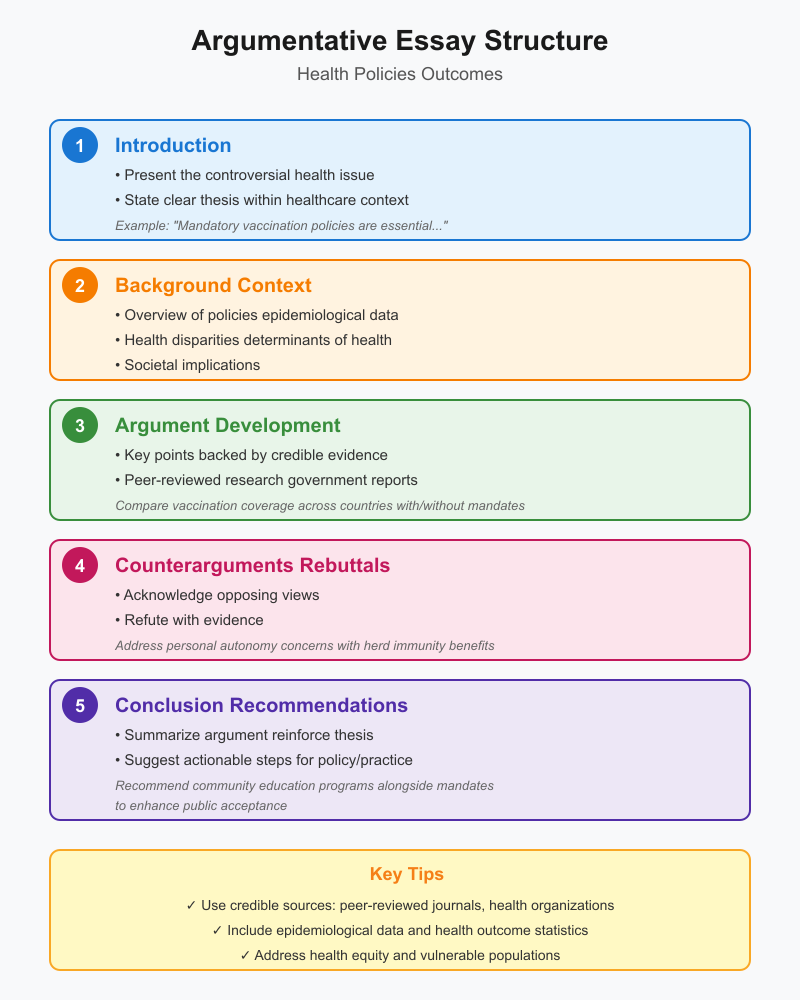
A well-structured argumentative essay in nursing or public health typically follows a clear framework:
- Introduction:
- Introduce the controversial issue, contextualize it within public health topics or healthcare systems, and state a clear thesis or stance.
- Example: “Mandatory vaccination policies are essential for controlling the spread of preventable diseases and protecting vulnerable populations.”
- Background and Context:
- Provide an overview of relevant policies, historical trends, or epidemiological data.
- Include discussion of health disparities, determinants of health, and societal implications.
- Argument Development:
- Present key points supporting the thesis, each backed by credible evidence from health research, government reports, or peer-reviewed literature.
- Use examples: For instance, comparing vaccination coverage and outbreak data across countries with and without mandates.
- Counterarguments and Rebuttals:
- Acknowledge opposing views, such as concerns about personal autonomy, and refute them with evidence.
- Example: Highlighting that herd immunity benefits outweigh individual resistance in public health planning.
- Conclusion and Recommendations:
- Summarize the argument, reinforce the thesis, and suggest actionable steps for policy, practice, or further research.
- Example: Recommending integration of community education programs alongside vaccination mandates to enhance public acceptance.
What are example argumentative essay topics involving health disparities or public health issues?
Health disparities and systemic inequities offer rich opportunities for argumentative essays because they illustrate the intersection of social, economic, and environmental factors on health outcomes. Potential topics include:
- Reducing racial and ethnic disparities in access to mental health services
- Policies to address food deserts and nutritional inequalities in urban communities
- Socioeconomic determinants of childhood obesity and preventive strategies
- The impact of housing insecurity on chronic disease management
- Health policy reforms to reduce maternal mortality disparities
- Community-based interventions to mitigate environmental health risks
- Access to telehealth and digital health equity during public health crises
- Ethical considerations in prioritizing healthcare resources for underserved populations
What topics to write for health and wellness, and how to find topic ideas?
Selecting meaningful topics for health and wellness essays involves aligning student interest with evidence-based concepts, practical applications, and broader public health relevance. Health and wellness are multidimensional, encompassing physical, mental, social, and environmental aspects of health. For nursing and public health students, essays on these topics not only fulfill academic objectives but also enhance understanding of health promotion, disease prevention, and holistic care.
To identify compelling topic ideas, students should start by reviewing current literature, public health reports, and peer-reviewed journals. For example, databases such as PubMed, CINAHL, and WHO publications provide insights into emerging issues, trends, and debates in health and wellness. Classroom discussions, clinical experiences, and observations from community health settings also serve as rich sources of inspiration. Consider reflecting on personal experiences in nursing practice or exposure to community health initiatives—these often highlight practical challenges and innovative solutions that can be explored in an essay.
Brainstorming exercises, such as listing areas of interest within personal health, preventive care, or lifestyle interventions, can also guide topic selection. Narrowing broad themes into focused areas ensures manageability; for example, rather than writing broadly about “healthy living,” a student might explore “the role of structured physical activity programs in improving mental well-being among college students.”
What wellness topics and health and wellness ideas are practical for student essays?
Effective wellness topics are those that are researchable, relevant to contemporary public health challenges, and applicable to personal or community health. Examples include:
- The impact of nutrition education on college student health and wellness
- Stress management techniques and mental well-being among nursing students
- The role of sleep hygiene in preventing chronic illness
- Exercise interventions for improving cardiovascular health in adults
- Mindfulness and relaxation strategies in workplace wellness programs
- Community initiatives to reduce obesity and promote healthy lifestyles
- The influence of social support networks on psychological health
- Technology-based interventions for monitoring personal wellness
- Integrating wellness education into nursing curricula
- Holistic approaches to patient care in nursing practice
These topics enable students to draw on health research, health promotion, and public health topics, providing evidence-based discussions and practical recommendations. Essays can explore measurable outcomes, compare intervention strategies, and discuss implications for both individual and community health and wellness.
How can I choose topic ideas related to health promotion and health policies?
Health promotion and health policies are closely linked because effective policies support systemic interventions that improve health outcomes. When choosing topic ideas in this domain, students should consider areas where policy impacts individual behavior or population-level well-being. Key strategies include:
- Identifying Current Issues: Review contemporary challenges in public health issues, such as vaccination uptake, workplace wellness, or chronic disease prevention. Topics can focus on how policies enhance or impede health promotion efforts.
- Example: “Evaluating the effectiveness of sugar-sweetened beverage taxes on reducing obesity rates in urban communities.”
- Linking Policy to Outcomes: Choose topics that examine the relationship between a specific policy and measurable health outcomes.
- Example: “Impact of smoke-free workplace laws on employee respiratory health and absenteeism.”
- Focusing on Preventive Interventions: Explore how policies promote preventive care, health and wellness, or community engagement.
- Example: “Community-based vaccination mandates: a strategy to improve population immunity and health equity.”
- Considering Feasibility and Scope: Ensure the topic is suitable for the assignment’s length and research depth, and that sufficient evidence exists for analysis. For students, narrowing a broad area of health promotion to a specific population, setting, or intervention enhances clarity and research quality.
- Integrating Evidence-Based Recommendations: Strong essays link health research topics and practical implications, discussing how interventions or policy changes can improve outcomes.
- Example: “Incorporating workplace wellness policies to reduce nurse burnout: evidence and best practices.”
Conclusion
Selecting the right health essay topic is a foundational step for nursing and public health students seeking to produce meaningful, research-based, and academically rigorous work. Throughout this guide, we have explored how to identify health topics that are both engaging and feasible, how to focus broad interests into structured research paper topics, and how to integrate practical insights from health research, medical research, and public health issues.
From examining mental health topics that support health and well-being to exploring health disparities, determinants of health, and occupational and environmental health, students have a wealth of options for crafting essays that are analytically robust and directly applicable to nursing practice or community health. Choosing interesting health topics to write about encourages critical thinking, facilitates evidence-based argumentation, and fosters understanding of the systemic, social, and individual factors influencing health outcomes.
Moreover, developing persuasive or health argumentative essay topics strengthens skills in evaluating health policies, proposing interventions, and addressing controversial issues with professionalism and evidence. Similarly, selecting topics related to health and wellness, health promotion, and personal health enables students to link theory with practice, demonstrating how lifestyle interventions, policy initiatives, and preventive strategies can improve individual and population health.
Ultimately, the process of identifying, refining, and researching a health essay topic equips students not only with academic skills but also with practical insights into public health, nursing, and clinical decision-making. By thoughtfully selecting topics, conducting rigorous health research, and applying evidence-based reasoning, students can produce essays that contribute meaningfully to scholarly discussion, advance their understanding of healthcare systems, and enhance their ability to address contemporary public health topics in professional practice.
Frequently Asked Questions
Which topic is best for research in public health?
The best topics in public health research are those that are relevant, evidence-based, and address pressing community or population health issues. Examples include vaccination programs, health disparities, mental health interventions, environmental health risks, and chronic disease prevention. These topics allow for practical analysis, policy evaluation, and measurable outcomes.
How do you choose a health essay topic?
To choose a health essay topic, start by identifying your interests within public health or nursing, review current literature and research gaps, consider the feasibility of conducting the study, and narrow broad themes into specific, researchable questions. For example, instead of “mental health,” focus on “the impact of workplace wellness programs on nurse burnout.”
What are the topics for health promotion in nursing?
Health promotion topics in nursing focus on prevention, education, and lifestyle interventions. Examples include:
- Community-based programs to reduce obesity
- Stress management strategies for nurses
- Vaccination awareness campaigns
- Patient education on chronic disease prevention
- Workplace wellness initiatives in healthcare settings
Which is the best topic for essay writing?
The best topic for essay writing is specific, evidence-supported, and relevant to current health challenges. It should allow critical analysis, integration of research, and practical application. For example: “Evaluating the effectiveness of school-based mental health programs in improving adolescent well-being” is focused, researchable, and meaningful.
