

Healthcare Argumentative Essay Topics: Good Argumentative Essay Topic Ideas for Nursing Essay, Medical Essay, and Health Essay Topics for College Students
Debates surrounding modern healthcare are increasingly shaping how nurses think, practice, and engage with evidence-based decision-making. From questions about equitable access to care and the role of policy in shaping outcomes, to ethical dilemmas arising from advances in the medical field, these discussions require more than surface-level opinions. For nursing students, engaging with a carefully selected essay topic is not simply an academic requirement; it is an opportunity to develop analytical reasoning, strengthen professional judgment, and learn how to communicate complex healthcare arguments clearly and responsibly.
Within nursing education, academic writing—whether an essay, a research paper, or a structured nursing essay—serves as a bridge between theory and real-world practice. Well-constructed argumentative essays challenge students to examine evidence, evaluate competing perspectives, and defend a position grounded in credible sources. Selecting the right argumentative essay topic is therefore a foundational step, especially when exploring health topics that intersect with public health, patient care, healthcare policies, and the realities of today’s healthcare system.
Controversial issues in healthcare are particularly valuable for learning because they reflect the complexity nurses face in clinical and community settings. Topics related to medical ethics, global health, mental health, environmental health, and healthcare access often provoke debate precisely because there are no simple answers. These areas encourage students to think critically about the implications of policy decisions, clinical guidelines, and social determinants of health, while also considering the perspectives of patients, families, and the broader healthcare professional community.
This article provides a structured exploration of healthcare argumentative essay topics relevant to nursing students and other college learners in health disciplines. It examines how to identify strong topic ideas, evaluate their relevance to nursing practice, and transform them into persuasive, evidence-supported arguments. By grounding academic writing in real healthcare challenges and contemporary debates, students can move beyond routine assignments and develop the skills needed for professional advocacy, ethical reasoning, and lifelong engagement with healthcare research and policy discussions.
What are the best essay topics for healthcare argumentative essays and nursing argumentative essay topics?
How to choose an essay topic that fits nursing practice and patient care
To choose a topic that aligns with nursing practice, students should begin by reflecting on issues they encounter in coursework, clinical placements, or current healthcare debates. An effective essay topic should connect theory to practice by addressing challenges nurses face in delivering safe, ethical, and effective care. For example, a topic examining nurse-to-patient ratios allows students to analyze how staffing policies influence patient outcomes, professional burnout, and healthcare quality.
A practical approach is to ask whether the topic:
- Reflects a real challenge in nursing or healthcare delivery
- Has sufficient scholarly evidence to support multiple perspectives
- Encourages critical thinking rather than simple description
Topics grounded in patient care—such as informed consent, end-of-life decision-making, or culturally competent care—are particularly suitable because they highlight the nurse’s role as both a caregiver and an advocate. When students consciously choose a topic that reflects professional values and clinical relevance, their writing becomes more persuasive and academically rigorous.
Top medical argumentative essay topics for research paper topics in the medical field
A. Nursing Practice and Clinical Decision-Making (25 Topics)
- Should nurse-to-patient ratios be legally mandated?
- Is bedside nursing documentation improving or hindering patient safety?
- Should nurses have greater autonomy in clinical decision-making?
- Are standardized care protocols limiting individualized nursing care?
- Should nurses be allowed to refuse assignments based on safety concerns?
- Is task delegation affecting the quality of nursing care?
- Should nursing judgment outweigh physician orders in critical situations?
- Are clinical checklists improving outcomes or reducing critical thinking?
- Should nurses play a stronger role in discharge planning?
- Is evidence-based practice always feasible in high-acuity settings?
- Should shift length limits be enforced for nurses?
- Are clinical simulations replacing real-world competency development?
- Should nurses be involved in hospital policy development?
- Is continuity of care compromised by rotating nursing assignments?
- Should specialty certification be mandatory for high-risk units?
- Are electronic health records improving nursing efficiency?
- Should nurses lead interdisciplinary care coordination?
- Is emotional labor adequately recognized in nursing practice?
- Should nurses be empowered to initiate preventive interventions?
- Are nursing workflows contributing to patient safety risks?
- Should nurses receive legal protection for whistleblowing?
- Is bedside handoff more effective than written reports?
- Should nursing workload be capped during emergencies?
- Are current nursing competencies aligned with modern healthcare needs?
- Should nurses be primary advocates in ethical decision-making?
B. Nursing Education and Professional Development (25 Topics)
- Should nursing education place greater emphasis on critical thinking?
- Is clinical placement quality more important than quantity?
- Should nursing students receive training in healthcare policy analysis?
- Are current nursing curricula preparing students for ethical dilemmas?
- Should interprofessional education be mandatory in nursing programs?
- Is reflective practice essential in nursing education?
- Should nursing programs require research literacy training?
- Are standardized exams effective measures of nursing competence?
- Should nursing education address workplace violence more explicitly?
- Is mentorship more effective than traditional clinical supervision?
- Should nursing students participate in healthcare advocacy projects?
- Are online nursing programs equivalent to traditional programs?
- Should nursing ethics be taught across all clinical courses?
- Is lifelong learning adequately supported in nursing careers?
- Should leadership training be mandatory for undergraduate nurses?
- Are nursing students prepared for end-of-life care discussions?
- Should nursing education focus more on community health?
- Is cultural competence adequately addressed in nursing programs?
- Should nursing faculty maintain active clinical practice?
- Are nursing students assessed fairly in clinical evaluations?
- Should global health experiences be integrated into nursing education?
- Is academic pressure affecting nursing student well-being?
- Should nursing programs include financial literacy education?
- Are current admission standards predictive of nursing success?
- Should nursing education emphasize resilience training?
C. Public Health and Population-Based Care (25 Topics)
- Should vaccination policies prioritize public safety over individual choice?
- Is mandatory vaccination ethically justified for healthcare workers?
- Should governments regulate misinformation during public health crises?
- Are pandemic restrictions effective in protecting vulnerable populations?
- Should public health funding prioritize prevention over treatment?
- Is contact tracing an invasion of privacy?
- Should health promotion be integrated into all nursing roles?
- Are community health nurses underutilized in healthcare systems?
- Should public health interventions be culturally tailored?
- Is health education more effective than regulation?
- Should schools be primary sites for public health interventions?
- Are public health campaigns addressing health inequities effectively?
- Should governments mandate lifestyle-related health interventions?
- Is population screening cost-effective for chronic diseases?
- Should public health nurses have expanded prescribing authority?
- Are global public health responses equitable across regions?
- Should environmental health risks be treated as public health emergencies?
- Is obesity a public health issue or personal responsibility?
- Should public health data sharing override privacy concerns?
- Are preventive services accessible to marginalized populations?
- Should public health policies focus on social determinants of health?
- Is community engagement essential for public health success?
- Should nurses lead public health advocacy initiatives?
- Are rural public health services adequately supported?
- Should public health emergencies override civil liberties?
D. Healthcare Policy, Systems, and Access (25 Topics)
- Should healthcare be recognized as a universal human right?
- Is privatization improving or weakening healthcare systems?
- Should governments regulate healthcare costs more aggressively?
- Are current healthcare policies addressing workforce shortages?
- Should nurses be involved in national healthcare policy reform?
- Is healthcare access equitable across socioeconomic groups?
- Should primary care be prioritized over tertiary services?
- Are healthcare reforms improving patient outcomes?
- Should healthcare funding be performance-based?
- Is insurance-based healthcare creating disparities?
- Should undocumented populations receive full healthcare access?
- Are healthcare systems prepared for aging populations?
- Should telehealth be permanently integrated into healthcare delivery?
- Is centralized healthcare governance more effective?
- Should rural healthcare receive targeted policy support?
- Are healthcare policies responsive to frontline worker needs?
- Should nurses influence legislative healthcare decisions?
- Is decentralization improving healthcare service delivery?
- Should healthcare spending prioritize preventive services?
- Are current healthcare policies patient-centered?
- Should healthcare access depend on employment status?
- Is healthcare system reform politically feasible?
- Should healthcare delivery models be standardized nationally?
- Are healthcare policies aligned with population health needs?
- Should nurses be policy advisors at governmental levels?
E. Medical Ethics and Professional Responsibility (25 Topics)
- Should patient autonomy override clinical judgment?
- Is assisted dying ethically justifiable in healthcare?
- Should nurses participate in ethically controversial procedures?
- Are advance directives respected in clinical practice?
- Should resource allocation prioritize survival probability?
- Is informed consent fully achievable in complex care?
- Should healthcare professionals disclose all medical errors?
- Are ethical guidelines keeping pace with medical innovation?
- Should family wishes override patient preferences?
- Is conscientious objection acceptable in nursing practice?
- Should ethics committees guide bedside decisions?
- Are end-of-life decisions influenced by institutional bias?
- Should nurses act as moral advocates for patients?
- Is patient confidentiality compromised by digital records?
- Should minors make independent healthcare decisions?
- Are ethical principles applied consistently in practice?
- Should nurses challenge unethical physician decisions?
- Is rationing care ethically defensible during crises?
- Should experimental treatments be offered to terminal patients?
- Are ethical standards culturally universal?
- Should nurses receive formal ethics mediation training?
- Is transparency always in the patient’s best interest?
- Should ethics education be mandatory for licensure?
- Are ethical dilemmas unavoidable in modern healthcare?
- Should moral distress be recognized as an occupational risk?
F. Mental Health and Psychological Care (25 Topics)
- Should mental health services be integrated into primary care?
- Is stigma the main barrier to mental health treatment?
- Should mental health screening be mandatory in schools?
- Are involuntary admissions ethically justified?
- Should mental health nurses have expanded roles?
- Is community-based mental healthcare more effective than institutional care?
- Should mental health be prioritized in healthcare funding?
- Are current mental health policies evidence-based?
- Should workplace mental health programs be mandatory?
- Is telepsychiatry effective for long-term care?
- Should nurses receive specialized mental health training?
- Are mental health services accessible to vulnerable populations?
- Should substance use disorders be treated as health conditions?
- Is criminalization worsening mental health outcomes?
- Should trauma-informed care be standard practice?
- Are mental health services culturally appropriate?
- Should mental health care be fully covered by insurance?
- Is burnout a systemic healthcare failure?
- Should nurses screen patients for mental distress routinely?
- Are current mental health interventions sustainable?
- Should peer support be integrated into mental healthcare?
- Is early intervention reducing long-term mental health burden?
- Should mental health data be shared across services?
- Are mental health nurses adequately supported?
- Should mental health care be community-led?
G. Medical Research, Innovation, and Technology (25 Topics)
- Should artificial intelligence guide clinical decision-making?
- Is technology widening healthcare inequalities?
- Should nurses be trained in health data analytics?
- Are clinical trials ethically conducted in low-income settings?
- Should experimental treatments bypass traditional approval processes?
- Is precision medicine improving patient outcomes?
- Should patient data be used for secondary research?
- Are wearable health devices improving preventive care?
- Should technology replace certain nursing tasks?
- Is innovation prioritized over patient safety?
- Should nurses be involved in research design?
- Are research findings effectively translated into practice?
- Should healthcare innovation focus on cost reduction?
- Is digital health improving continuity of care?
- Should research funding prioritize chronic disease?
- Are medical innovations accessible globally?
- Should open-access publishing be mandatory in healthcare research?
- Is technology increasing clinician burnout?
- Should research ethics boards include nurses?
- Are clinical guidelines overly dependent on research trials?
- Should innovation be regulated more strictly?
- Is medical research influenced by commercial interests?
- Should patient-reported outcomes guide innovation?
- Are emerging technologies adequately evaluated?
- Should nurses lead practice-based research initiatives?
H. Global, Environmental, and Future Health Challenges (25 Topics)
- Should climate change be treated as a healthcare emergency?
- Are healthcare systems prepared for future pandemics?
- Should nurses play leadership roles in global health initiatives?
- Is environmental pollution a primary driver of disease?
- Should healthcare systems reduce their environmental footprint?
- Are global health resources distributed equitably?
- Should developed nations fund global health programs?
- Is antimicrobial resistance a policy failure?
- Should environmental health risks be integrated into care planning?
- Are global health priorities aligned with local needs?
- Should nurses participate in international disaster response?
- Is global health governance effective?
- Should climate-related health education be mandatory?
- Are future healthcare models sustainable?
- Should healthcare planning include climate adaptation strategies?
- Is environmental justice a healthcare responsibility?
- Should global health data sharing be expanded?
- Are vulnerable populations protected from environmental health risks?
- Should nurses advocate for environmental policy reform?
- Is healthcare prepared for demographic transitions?
- Should global health ethics guide international aid?
- Are future health threats adequately researched?
- Should healthcare systems adopt green technologies?
- Is global collaboration essential for health security?
- Should environmental health be a core nursing competency?
Good argumentative essay topic examples for health topics and nurse essay topics
These topics are framed to be clearly debatable, academically appropriate, and relevant to nursing students, while supporting strong argument development.
Nursing Practice and Patient-Centered Care
- Should nurses have greater authority in clinical decision-making?
- Are nurse-to-patient ratios the most critical factor in patient safety?
- Should nurses be legally protected when refusing unsafe assignments?
- Is patient-centered care achievable in understaffed healthcare settings?
- Should nurses lead care coordination for patients with chronic illness?
- Does increased documentation reduce time for direct patient care?
- Should bedside handovers replace written nursing reports?
- Are current nursing workloads compromising ethical standards?
- Should nurses be empowered to initiate preventive care interventions?
- Is continuity of care more important than task efficiency in nursing?
Nursing Education and Professional Responsibility
- Should nursing education focus more on ethical decision-making than technical skills?
- Are nursing students adequately prepared for real-world clinical stress?
- Should clinical simulation replace a portion of hospital-based training?
- Is leadership training essential for all nursing students?
- Should nursing students be assessed more on critical thinking than exams?
- Are current nursing curricula aligned with modern healthcare needs?
- Should research literacy be mandatory in undergraduate nursing programs?
- Is mentorship more effective than traditional clinical supervision?
- Should nursing students participate in healthcare policy discussions?
- Does academic pressure negatively affect nursing student performance?
Public Health and Community Health Topics
- Should vaccination policies prioritize public safety over personal choice?
- Is public health education more effective than regulation?
- Should nurses play a leading role in community health promotion?
- Are public health campaigns effective in reducing health disparities?
- Should schools be used as primary sites for health interventions?
- Is access to healthcare a fundamental human right?
- Should governments invest more in preventive health programs?
- Are rural communities underserved by public health systems?
- Should public health responses consider cultural differences more strongly?
- Is lifestyle-related disease a public health responsibility?
Ethical and Legal Issues in Healthcare
- Should patient autonomy override clinical judgment in all cases?
- Is assisted dying ethically acceptable in modern healthcare?
- Should nurses disclose all medical errors to patients?
- Are ethical guidelines keeping pace with advances in medicine?
- Should nurses challenge physician decisions they believe are unethical?
- Is informed consent truly possible in complex medical situations?
- Should healthcare resources be rationed during emergencies?
- Is confidentiality at risk in digital healthcare systems?
- Should minors have the right to make independent health decisions?
- Is moral distress an unavoidable part of nursing practice?
Mental Health and Emerging Health Challenges
- Should mental health care be integrated into primary healthcare services?
- Is stigma the biggest barrier to mental health treatment?
- Should mental health screening be mandatory in healthcare settings?
- Are community-based mental health services more effective than institutional care?
- Should nurses receive specialized training in mental health care?
- Is burnout a systemic failure of the healthcare system?
- Should healthcare organizations be responsible for staff mental well-being?
- Are mental health services accessible to vulnerable populations?
- Should trauma-informed care be standard nursing practice?
- Is early mental health intervention cost-effective for healthcare systems?
How do I write a persuasive essay on public health or health policies?
Writing a persuasive essay on public health or health policies requires a strategic approach that combines evidence-based reasoning, ethical considerations, and an understanding of healthcare systems. A well-crafted persuasive essay goes beyond presenting facts; it articulates a clear stance, supports that stance with credible evidence, and demonstrates why adopting a particular viewpoint benefits both individuals and the broader population. For nursing students and healthcare learners, persuasive essays also serve as an opportunity to critically engage with current healthcare debates, policy decisions, and patient-centered outcomes.
A strong essay begins with a clear understanding of the topic. For example, a student may choose a health essay topic such as “Mandatory vaccination policies for healthcare workers” or “Expanding telehealth access in rural communities.” These topics are well-suited for persuasive writing because they involve societal, ethical, and professional considerations. Framing the issue in terms of nursing practice or patient care can make the argument more relevant, highlighting how policy decisions affect frontline healthcare delivery.
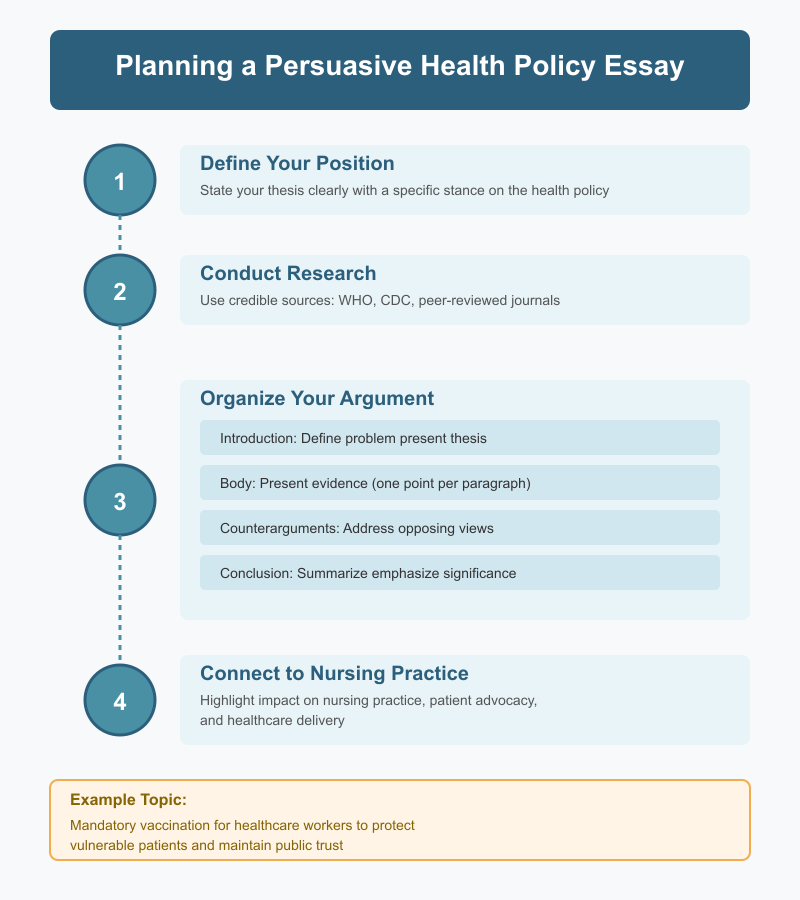
Steps to plan a persuasive essay about health policies and public health
- Define Your Position: Start by clearly stating your thesis. For instance, a nursing student writing on vaccination policies might argue that mandatory vaccination for healthcare workers is necessary to protect vulnerable patients and maintain public trust. A precise thesis sets the foundation for all subsequent arguments.
- Conduct Research and Select Sources: Identify medical research studies, government reports, and policy analyses that support your position. Using reputable sources such as the World Health Organization, Centers for Disease Control and Prevention, or peer-reviewed journals ensures credibility. For example, studies demonstrating reduced hospital-acquired infections after healthcare worker vaccination can strengthen your essay.
- Organize Your Argument: Create an outline with a logical progression of ideas. Typical sections include:
- Introduction – Define the problem and present your thesis.
- Body Paragraphs – Present evidence supporting your stance. Each paragraph should focus on one main point, such as public safety, ethical responsibility, or cost-effectiveness.
- Counterarguments – Address opposing viewpoints to demonstrate critical thinking and reinforce your credibility.
- Conclusion – Summarize your argument and emphasize the significance of your position for public health, healthcare professionals, and patient outcomes.
- Ensure Relevance to Nursing and Public Health: When planning the essay, highlight how your topic affects nursing practice, patient advocacy, and health policy implementation. For example, a topic on telehealth expansion can include discussion on how nurses support virtual patient monitoring and enhance healthcare delivery in underserved areas.
Research topics and medical research sources to support a persuasive health essay
The foundation of any persuasive essay is high-quality evidence. Research topics related to your essay should be relevant, current, and credible. Examples of supporting research might include:
- Clinical studies: Demonstrating outcomes of vaccination, screening programs, or chronic disease management.
- Policy analyses: Evaluating the effectiveness of health policies like smoke-free legislation or pandemic response measures.
- Public health data: Statistical evidence highlighting health disparities, access issues, or trends in chronic disease prevalence.
For example, if writing a healthcare argumentative essay topic on mandatory mental health screening for healthcare workers, a student can use research on stress-related absenteeism, patient safety outcomes, and organizational cost savings. Integrating these sources strengthens the persuasive essay by grounding opinions in scientific evidence and real-world implications.
Common persuasive strategies for health essay topic arguments
Effective persuasion in healthcare relies on combining multiple strategies:
- Evidence-Based Reasoning: Use statistics, case studies, and published research to support claims. For instance, citing CDC reports on infection rates reinforces arguments for vaccination policies.
- Ethical Appeals: Address moral considerations, such as patient safety, equity, and professional responsibility. Nurses, for example, have an ethical duty to advocate for policies that protect vulnerable populations.
- Case Examples: Incorporate real-life scenarios or historical examples. A discussion of hospital outbreaks prevented through vaccination or nurse-led health promotion programs can make abstract policies tangible.
- Counterarguments: Recognize opposing perspectives, such as concerns about personal freedom in public health mandates. Refuting counterarguments using evidence demonstrates analytical depth.
- Clarity and Structure: Organize arguments logically, ensuring each paragraph supports the thesis. Strong transitions and clear topic sentences make the essay persuasive and readable.
- Policy Implications: Link arguments to broader healthcare policies and system-level outcomes. For example, advocating for telehealth policies can be reinforced by showing improvements in rural healthcare access and reduced hospitalization rates.
Example Integration
Suppose a nursing student is tasked with a persuasive essay on public health regarding “Mandatory COVID-19 vaccination for healthcare workers.” A strong essay might include:
- Evidence-Based Argument: Citing research showing reduced transmission in hospitals after mandatory vaccination.
- Ethical Appeal: Emphasizing nurses’ duty to protect immunocompromised patients.
- Counterargument Addressed: Discussing concerns about autonomy and providing data on legal precedents supporting mandatory vaccination in healthcare settings.
- Policy Relevance: Linking the discussion to national healthcare policies and organizational protocols.
What are controversial health topics and interesting health paper topics worth debating?
In healthcare education, controversial topics are essential for cultivating critical thinking, analytical reasoning, and professional judgment. For nursing students, engaging with contentious issues encourages the development of skills needed for evidence-based decision-making, ethical reasoning, and policy advocacy. Controversial health topics often intersect with clinical practice, public health, medical research, and the healthcare system, providing rich opportunities for essay writing and academic exploration. Selecting these topics for an argumentative essay allows students to evaluate competing perspectives, weigh evidence, and construct persuasive arguments that are grounded in professional and ethical standards.
Controversial medical research and healthcare system debates to write an essay about
The medical field frequently presents debates where ethical, scientific, and societal considerations collide. Topics in this domain are particularly valuable because they require students to balance clinical outcomes with patient rights and system-level implications. Examples include:
- Genetic editing and CRISPR technology: Should humans have the right to alter genetic makeup for disease prevention, and what are the ethical implications?
- Stem cell research: Is using embryonic stem cells justified if it advances treatment options?
- AI-driven diagnostics and automation in healthcare: Are algorithms a reliable substitute for human clinical judgment, or do they introduce bias and risk?
- Healthcare rationing and resource allocation: How should limited resources like ICU beds or organ transplants be distributed ethically?
These debates also extend to the healthcare system itself. Questions about privatization versus universal healthcare, access to care, and nurse-to-patient ratios are ripe for argumentative exploration. A student could write an essay on health policies addressing whether healthcare systems should prioritize preventive care, and how that choice impacts patient outcomes and nursing practice.
Public health controversies: vaccination, pandemic policy, and global health
Public health provides a particularly fertile ground for controversial health essay topics because it involves societal obligations, policy implementation, and population-level outcomes. Some current debates include:
- Vaccination policies: Should vaccination be mandatory for certain populations, such as healthcare workers, school children, or vulnerable adults? Students can explore scientific evidence supporting efficacy, ethical considerations around personal freedom, and implications for patient care.
- Pandemic policy responses: During global health crises like COVID-19, policies on lockdowns, mask mandates, and travel restrictions provoke debate. Essays can examine the balance between public health protection and individual rights, as well as the role of nurses in enforcing or advocating for these policies.
- Global health equity: Should wealthy nations bear responsibility for improving healthcare access in low-income countries? This debate allows students to discuss global health, resource distribution, and the ethics of international medical aid.
These topics are particularly effective for persuasive or argumentative essays because they require students to integrate research topics, ethical reasoning, and real-world implications. For example, a paper arguing for universal vaccination policies could combine epidemiological data, case studies of outbreaks, and analysis of healthcare policies affecting nursing practice.
How to turn controversial topics into strong argumentative essays and research papers
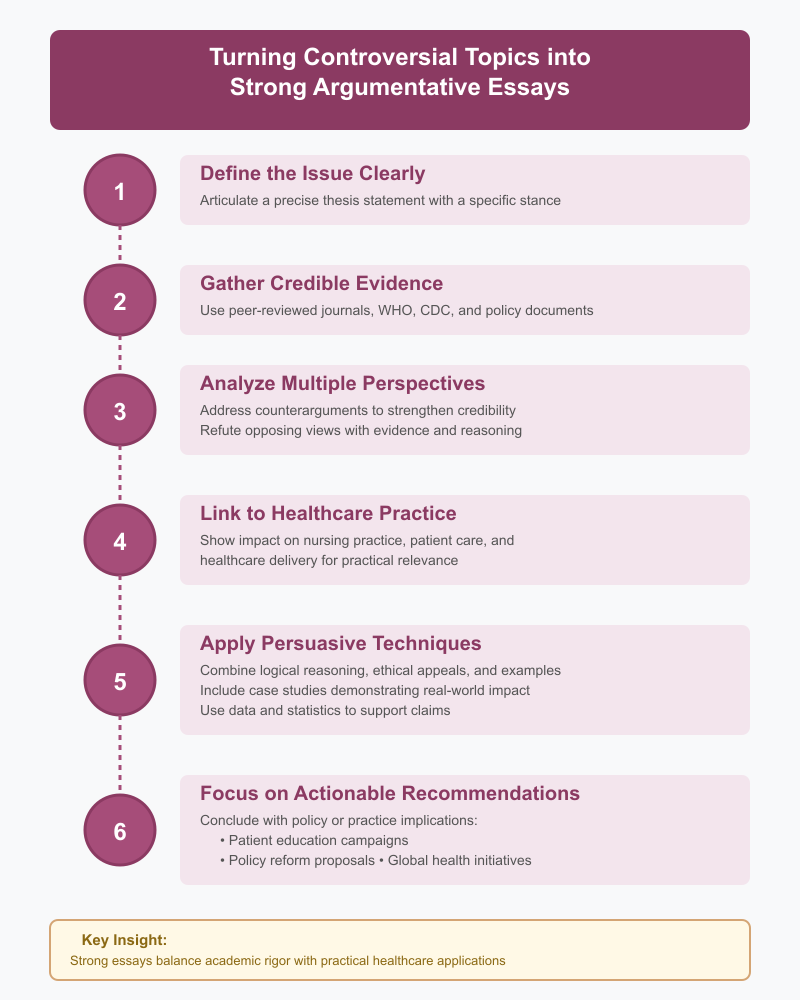
Transforming a controversial issue into a compelling healthcare argumentative essay topic involves several key steps:
- Define the Issue Clearly: Begin with a precise thesis that articulates the stance. For example, “Mandatory vaccination of healthcare workers is essential to protect vulnerable patients and maintain healthcare system integrity.” Clear framing helps guide research and argument structure.
- Gather Credible Evidence: Use medical research and policy reports to support arguments. Peer-reviewed journals, WHO guidelines, CDC statistics, and government health policy documents provide authoritative backing.
- Analyze Multiple Perspectives: Address counterarguments to strengthen credibility. For instance, in vaccination debates, consider ethical objections and personal autonomy concerns, and refute them using evidence and public health rationale.
- Link to Healthcare Practice and Policy: Illustrate how the issue affects nursing practice, patient care, and healthcare delivery. Demonstrating relevance ensures that essays are practical as well as academic.
- Apply Persuasive Writing Techniques: Use a combination of logical reasoning, ethical appeals, and illustrative examples to persuade readers. For example, including case studies where vaccination prevented outbreaks can be compelling evidence in a policy-focused essay.
- Focus on Actionable Recommendations: A strong research paper or essay often concludes with implications for policy or practice, such as advocating for nursing-led patient education campaigns, policy reform, or global health initiatives.
By following these steps, nursing students can turn controversial medical and healthcare topics into high-quality argumentative essays or research papers that demonstrate critical thinking, evidence-based reasoning, and professional insight. These assignments not only enhance academic skills but also prepare students for the complex ethical and practical challenges of modern healthcare delivery and public health advocacy.
Which mental health essay topics and healthcare argumentative essay topics are suitable for students?
Mental health remains one of the most pressing areas within modern healthcare, intersecting clinical practice, public health policy, and nursing practice. For nursing students and other healthcare learners, exploring mental health essay topics and healthcare argumentative essay topics provides an opportunity to develop critical thinking, ethical reasoning, and research skills. Selecting a suitable topic involves balancing relevance, feasibility, and the potential to generate meaningful discussion while addressing the realities of patient care and nursing practice.
High-impact mental health essay topic ideas for essay topics for students
When identifying high-impact mental health essay topics, students should consider issues that are contemporary, ethically significant, and supported by credible medical research. Some examples include:
- The Role of Nurses in Early Identification of Mental Health Disorders – Examining how nurses can screen for depression, anxiety, or post-traumatic stress disorder (PTSD) in clinical and community settings.
- Telepsychiatry and Mental Health Access – Evaluating the effectiveness and challenges of remote mental health services, especially in underserved populations.
- Stigma and Mental Health Care – Discussing strategies to reduce societal and institutional stigma, with implications for nursing advocacy.
- Burnout and Occupational Stress Among Healthcare Professionals – Assessing causes, effects, and interventions to support mental well-being in nursing staff.
- The Ethics of Involuntary Psychiatric Treatment – Exploring patient autonomy versus public safety in psychiatric care.
- Adolescent Mental Health in School Settings – Evaluating programs for early detection and intervention.
- Mental Health Disparities Among Minority Populations – Analyzing the social determinants of mental health and access barriers.
- Integrating Mental Health Into Primary Care – Investigating models that combine physical and psychological care in clinical practice.
- Substance Use Disorders and Co-Occurring Mental Illness – Examining the challenges of dual diagnoses and nursing interventions.
- Postpartum Depression and Maternal Health – Evaluating screening, treatment, and support strategies in maternal care settings.
Research paper topics in mental health and psychological care
For students pursuing research paper topics, it is essential to focus on areas that allow integration of empirical studies, clinical guidelines, and policy frameworks. Examples include:
- The Efficacy of Cognitive Behavioral Therapy in Treating Anxiety Disorders – A systematic review or meta-analysis approach.
- Impact of COVID-19 on Healthcare Workers’ Mental Health – Researching stress, burnout, and coping strategies among nurses.
- Role of Nurse-Led Interventions in Managing PTSD in Veterans – Evaluating clinical outcomes and patient satisfaction.
- Mental Health Screening Tools in Primary Care – Comparing the validity and reliability of different assessment methods.
- Effectiveness of Mindfulness Programs in Reducing Nurse Burnout – Combining quantitative and qualitative research methods.
- Digital Mental Health Interventions for Adolescents – Assessing outcomes, accessibility, and ethical considerations.
- Suicide Prevention Strategies in Hospital Settings – Exploring multidisciplinary approaches and nursing responsibilities.
- Cross-Cultural Perspectives on Mental Health Care – Studying culturally competent practices and their impact on patient outcomes.
- School-Based Mental Health Programs and Student Well-Being – Evaluating effectiveness and long-term benefits.
- Legal and Ethical Implications of Psychiatric Involuntary Treatment – Researching frameworks, patient rights, and professional accountability.
Tips for student-friendly nursing essay and nurse essay topics
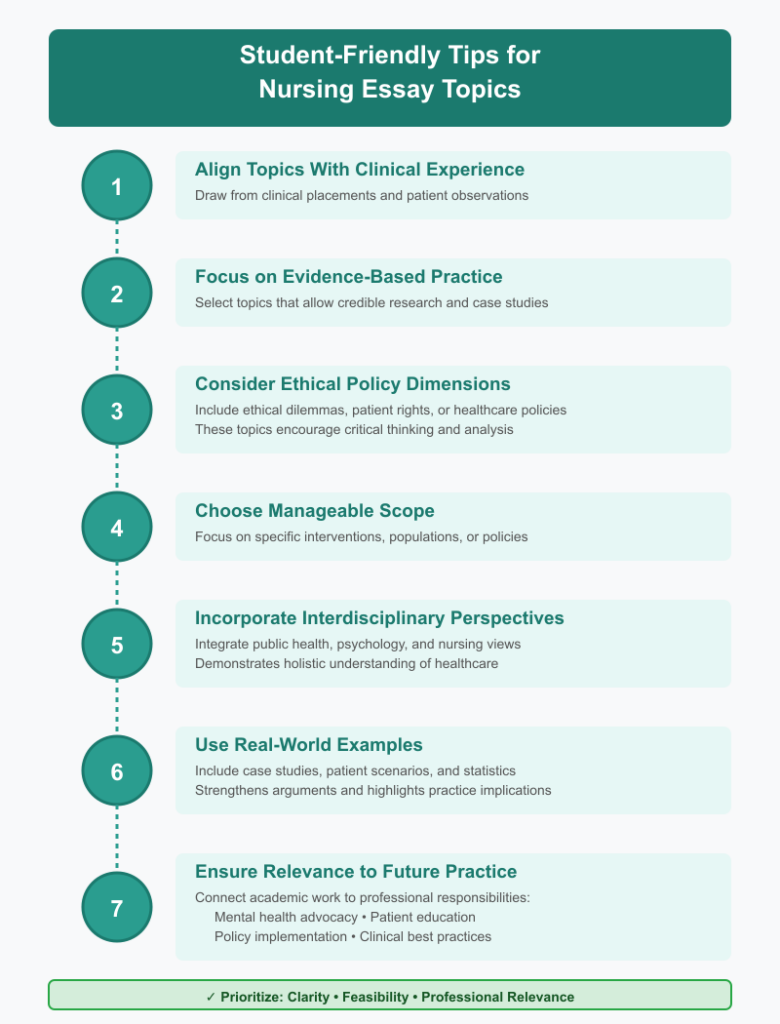
When choosing nursing essay or nurse essay topics, students should prioritize clarity, feasibility, and professional relevance. Here are key strategies:
- Align Topics With Clinical Experience: Use observations from clinical placements to inform essays. For example, encountering patients with anxiety disorders can inspire essays on early intervention strategies.
- Focus on Evidence-Based Practice: Ensure that topics allow incorporation of credible medical research, guidelines, and case studies.
- Consider Ethical and Policy Dimensions: Topics that include ethical dilemmas, patient rights, or healthcare policies are particularly compelling. For instance, debating involuntary treatment of psychiatric patients encourages critical thinking.
- Choose Manageable Scope: Avoid overly broad topics; focus on specific interventions, populations, or policy issues to produce a well-structured essay.
- Incorporate Interdisciplinary Perspectives: Topics integrating public health, psychology, and nursing perspectives can enrich arguments and demonstrate holistic understanding.
- Use Real-World Examples: Case studies, patient scenarios, and statistical data strengthen arguments and highlight nursing practice implications.
- Ensure Relevance to Students’ Future Practice: Essays should help students connect academic work to professional responsibilities, such as mental health advocacy, patient education, or policy implementation.
How to develop a research paper or argumentative essays on healthcare policies and health challenges?
Developing a high-quality research paper or argumentative essay on healthcare policies and health challenges requires a structured approach that integrates evidence-based practice, policy analysis, and real-world healthcare implications. For nursing students and healthcare learners, such essays are more than academic exercises—they cultivate skills in critical thinking, nursing research, and policy evaluation, all of which are essential for effective nursing practice and healthcare delivery.
Framing research topics around healthcare policies and health challenges
The first step in creating a compelling healthcare argumentative essay topic is identifying a precise focus. Students should select topics that balance feasibility, relevance, and impact. For example, rather than tackling “global health” in general, one might explore “The effectiveness of universal vaccination policies in reducing preventable diseases in low-income countries.” Similarly, a health essay topic like “Reducing nurse burnout through policy-driven staffing reforms” allows for both research and practical application in nursing practice.
When framing research topics:
- Identify the Problem Clearly: Define the healthcare challenge or policy issue, such as healthcare access inequities, pandemic preparedness, or workforce shortages.
- Consider Scope and Specificity: Topics should be narrow enough to allow in-depth analysis but broad enough to incorporate multiple sources and perspectives. For example, “Telehealth policy implementation during pandemics” is focused yet allows discussion of technology, policy, and patient care.
- Ensure Professional Relevance: Topics should relate to nursing students’ future practice, such as policies affecting patient safety, mental health services, or healthcare delivery systems.
By carefully framing topics, students set the stage for persuasive and well-supported arguments that resonate both academically and professionally.
Combining medical research and policy analysis in a convincing argumentative essay
A convincing essay combines medical research evidence with thorough policy analysis. This approach strengthens the argument by connecting empirical data to actionable healthcare policies. For instance:
- A research paper on healthcare policies to reduce hospital-acquired infections could incorporate epidemiological data, case studies, and nursing research on infection control practices.
- An argumentative essay on mental health policy reform might draw on peer-reviewed studies on treatment accessibility, cost-effectiveness analyses, and current legal frameworks.
Key strategies include:
- Evidence Integration: Support claims with credible medical research, such as systematic reviews, government reports, and peer-reviewed studies. Example: Citing CDC data showing reduced mortality after implementing mandatory nurse staffing policies strengthens an argument for policy change.
- Policy Contextualization: Link research findings to specific healthcare policies. For instance, demonstrating how health policies influence nursing workloads, patient safety, or preventive care highlights real-world relevance.
- Critical Evaluation: Assess both benefits and limitations of existing policies or interventions. An essay could explore how pandemic response policies improved outcomes in some regions while creating inequities in others.
- Professional Implications: Discuss the role of healthcare professionals in policy implementation and advocacy. For example, nurses may act as frontline implementers of vaccination policies or mental health initiatives.
Choosing paper topics that address global health and the healthcare system
Global health is an increasingly important dimension for research paper topics in healthcare, particularly for nursing students interested in public health and healthcare system improvements. Topics should capture challenges that are transnational, systemically significant, and evidence-based. Examples include:
- Global Vaccination Policies: Examining disparities in vaccination coverage and strategies to improve uptake in low- and middle-income countries.
- Pandemic Preparedness and Response: Analyzing lessons from COVID-19 to inform healthcare policies and nursing interventions globally.
- Healthcare Access Inequities: Investigating barriers to care in underserved populations, including resource allocation and social determinants of health.
- Nursing Workforce Challenges: Evaluating global nursing shortages and policy strategies to optimize staffing and healthcare delivery.
- Telehealth and Digital Health Policies: Assessing global adoption, regulatory barriers, and patient outcomes across different healthcare systems.
Conclusion
Healthcare argumentative essays and nursing essay topics offer students a unique opportunity to engage critically with complex issues at the intersection of clinical practice, policy, and public health. By exploring healthcare policies, medical research, and health challenges, students develop the analytical skills necessary to evaluate evidence, consider ethical implications, and advocate for patient-centered care. Controversial topics—ranging from mental health access and vaccination mandates to global health disparities and pandemic preparedness—encourage thoughtful debate and require learners to balance competing perspectives with empirical evidence.
For nursing students, mastering essay writing in these areas is more than an academic exercise; it reinforces professional competencies such as ethical reasoning, research literacy, and policy analysis, all of which are essential for effective nursing practice and healthcare delivery. Selecting relevant, focused essay topics, framing arguments clearly, and integrating credible medical research ensures that essays are persuasive, rigorous, and practically meaningful.
Ultimately, developing a compelling argumentative essay or research paper equips students to navigate real-world healthcare challenges, contribute to policy discussions, and influence positive change within healthcare systems. Whether addressing public health issues, ethical dilemmas, or systemic reforms, these essays cultivate the critical thinking, advocacy, and professional insight necessary to advance both nursing education and patient care.
Frequently Asked Questions
What are some good argumentative essay topics?
Good argumentative essay topics are debatable, relevant, and supported by evidence. Examples include:
- Should vaccination be mandatory for healthcare workers?
- Is telehealth an effective substitute for in-person care?
- Should mental health services be integrated into primary care?
- Are nurse-to-patient ratios critical for patient safety?
- Is universal healthcare a human right?
How do you choose a health essay topic?
To choose a health essay topic, consider:
- Relevance: Align with current healthcare issues or public health concerns.
- Scope: Narrow enough to explore deeply but broad enough to find research.
- Interest and expertise: Pick a topic that engages you and relates to your nursing or medical knowledge.
- Availability of evidence: Ensure credible medical research and policy sources exist to support your argument.
What is the best health topic?
The best health topic is one that is timely, impactful, and allows exploration from multiple perspectives. Examples include:
- Mental health access among adolescents
- Pandemic preparedness and healthcare policy
- Global vaccination equity
- Healthcare workforce shortages and staffing policies
What is a good thesis statement for health care?
A good thesis statement is clear, specific, and takes a position. Examples:
- “Mandatory vaccination for healthcare workers is essential to protect patients and prevent hospital-acquired infections.”
- “Integrating mental health services into primary care improves patient outcomes and reduces healthcare costs.”
- “Telehealth should be expanded in rural areas to increase access to quality healthcare while maintaining patient safety.”
