

Best Persuasive Speech Topics for Students: A Guide to Good Persuasive Speech Ideas
Developing the ability to argue thoughtfully and convincingly is a core academic skill in nursing education, closely tied to clinical reasoning, ethical decision-making, and patient advocacy. Within this context, Persuasive Speech Topics serve as more than classroom assignments; they provide structured opportunities for nursing students to practice translating evidence into clear, reasoned positions that can influence practice, policy, and professional dialogue. Much like clinical documentation or care planning, effective persuasion requires clarity, organization, and a firm grounding in credible evidence.
In nursing programs, persuasive speeches often ask students to take a stance on issues such as patient safety, ethical dilemmas, public health priorities, or healthcare policy. Selecting an appropriate persuasive speech topic is therefore an academic and professional decision, one that shapes how well a student can integrate research findings, clinical experience, and ethical principles into a coherent argument. A well-chosen topic supports not only academic performance but also the broader goal of preparing nurses to communicate persuasively with patients, colleagues, and interdisciplinary teams.
A good persuasive speech in nursing does not rely on emotional appeal alone. Instead, it balances logical reasoning, clinical evidence, and ethical sensitivity, reflecting the standards of evidence-based practice emphasized in nursing education. Through this process, students refine skills that extend beyond the classroom, including critical thinking, scholarly inquiry, and professional public speaking—all essential for leadership, advocacy, and lifelong learning in healthcare.
This guide is designed to support nursing students as they navigate the process of identifying, refining, and developing effective speech ideas. By examining how to align academic expectations with clinical relevance, and by exploring examples rooted in real nursing challenges, the sections that follow aim to clarify how persuasive speaking can strengthen both academic work and professional readiness. Rather than focusing on performance alone, the discussion emphasizes persuasion as a disciplined, evidence-informed form of communication that reflects the values and responsibilities of the nursing profession.
What persuasive speeches should nursing students consider when choosing a topic?
When nursing students begin the process of preparing a persuasive speech, the first step is to examine the landscape of issues that resonate deeply with both the profession and the audience. Persuasive speeches for nursing students should be rooted in relevant patient care challenges, ethical considerations, clinical practice improvements, and broader health system concerns. In essence, the best speeches highlight real-world implications that nursing professionals encounter daily and encourage thoughtful deliberation rather than superficial argumentation.
Topics that explore patient-centered care—such as advocating for improved nurse-patient communication or arguing for the adoption of evidence-based safety practices—can serve as compelling material because they invite both cognitive and emotional engagement. For example, a topic that persuades healthcare teams to adopt structured interdisciplinary bedside rounds can be effective since research shows coordinated team discussion at the patient’s bedside improves care quality and collaboration.
How do I pick a persuasive speech topic related to patient care?
Choosing a persuasive speech topic closely tied to patient care begins with identifying issues that are both meaningful to clinical practice and supported by accessible evidence. Start by reflecting on your clinical experiences: moments when you observed outcomes change due to practice differences, such as pain management approaches or infection prevention protocols. If a certain practice sparked debate during clinical rotations—like the use of pain scales to guide analgesia decisions—that could form the basis of a focused argument.
To narrow your topic, consider framing it around a specific change you want to advocate for in patient care. For instance, “Implementing bedside shift reports to improve patient satisfaction and safety” is persuasive because it combines a clear claim with a growing body of evidence supporting improved communication and reduced errors. Topics like advocating for enhanced evidence-based practice in wound care or nurse-led patient education programs bring clinical evidence into your persuasive argument, grounding your speech in research and practice rather than opinion.
Top 100 Persuasive Speech Topics Related to Patient Care
Patient Safety and Quality of Care
- Mandatory nurse-to-patient ratios to reduce medical errors
- Bedside shift reporting as a strategy to improve patient safety
- The role of nurses in preventing hospital-acquired infections
- Standardized handoff communication to reduce adverse events
- Medication double-check systems in high-risk hospital units
- The impact of nurse fatigue on patient outcomes
- Fall-prevention protocols for elderly hospitalized patients
- Early warning scoring systems in acute care settings
- Reducing pressure injuries through routine skin assessments
- Patient safety benefits of hourly nursing rounds
Pain Management and Comfort
- Non-pharmacological pain management as a nursing priority
- Nurse-led pain assessment improves postoperative recovery
- Balancing opioid use and patient comfort in acute care
- Individualized pain management plans for chronic pain patients
- The role of nurses in addressing pain bias and undertreatment
Patient Education and Engagement
- Nurse-led patient education reduces hospital readmissions
- Teaching self-care skills to patients with chronic illness
- Health literacy as a determinant of patient outcomes
- The importance of discharge education in preventing complications
- Visual teaching tools to improve patient understanding
- Family involvement in patient education plans
Ethical and Legal Aspects of Patient Care
- Protecting patient autonomy in clinical decision-making
- Ethical challenges in end-of-life nursing care
- Nurses’ role in informed consent processes
- Balancing patient confidentiality with family involvement
- Ethical implications of life-sustaining treatment decisions
- Advocacy for vulnerable patient populations
Cultural Competence and Equity
- Cultural competence training improves patient satisfaction
- Addressing language barriers in healthcare delivery
- Reducing healthcare disparities through nurse advocacy
- Culturally sensitive care for diverse patient populations
- Implicit bias in nursing care and patient outcomes
- Respecting cultural beliefs in pain and end-of-life care
Mental Health and Emotional Support
- Integrating mental health screening into routine nursing care
- The role of nurses in suicide prevention
- Therapeutic communication in mental health nursing
- Reducing stigma toward patients with mental illness
- Trauma-informed care in emergency and acute settings
Technology and Innovation in Patient Care
- Electronic health records improve continuity of patient care
- Telehealth nursing and access to care in rural populations
- Mobile health apps for chronic disease management
- Smart infusion pumps and medication safety
- Wearable health technology in patient monitoring
Chronic Disease Management
- Nurse-led clinics for diabetes management
- Patient-centered care models for heart failure patients
- Self-management education for patients with hypertension
- Preventing complications in patients with chronic respiratory disease
- The nurse’s role in long-term cancer care support
Communication and Interprofessional Collaboration
- Nurse-physician collaboration and patient outcomes
- Interdisciplinary care teams in complex patient management
- Effective communication during patient transfers
- Conflict resolution in healthcare teams to protect patient care
Infection Prevention and Control
- Hand hygiene compliance and patient safety
- Nurse-driven infection surveillance programs
- Isolation protocols for infectious diseases
- Vaccination advocacy in clinical nursing practice
Patient Advocacy and Rights
- Nurses as advocates for safe staffing policies
- Protecting patient dignity during hospitalization
- Reporting unsafe practices without fear of retaliation
- Supporting patient decision-making in complex care situations
Geriatric and Pediatric Care
- Preventing polypharmacy in older adults
- Promoting mobility in hospitalized elderly patients
- Family-centered care in pediatric nursing
- Pain assessment challenges in nonverbal patients
End-of-Life and Palliative Care
- Early integration of palliative care improves quality of life
- Nurse communication skills in end-of-life discussions
- Supporting families during terminal illness
- Ethical decision-making in hospice care
Nutrition and Basic Care
- Preventing malnutrition in hospitalized patients
- Nurse monitoring of hydration status
- Nutrition education for patients with chronic illness
Workplace Environment and Patient Outcomes
- Supportive nursing work environments improve patient care
- Burnout prevention as a patient safety strategy
- Continuing education for nurses and quality of care
Special Populations and Settings
- Improving care for patients with disabilities
- Addressing substance use disorders in nursing care
- Prison healthcare and patient rights
- Homeless patient care challenges
Preventive and Community Care
- Community nursing interventions reduce hospital admissions
- Preventive screenings led by nurses
- School nursing and early health intervention
- Home health nursing and patient independence
Emerging and Thought-Provoking Topics
- Artificial intelligence in nursing decision support
- Ethical use of patient data in healthcare technology
- Climate change and its impact on patient health
- Disaster preparedness and nursing response
Patient Experience and Satisfaction
- Compassionate care and patient satisfaction scores
- The impact of nurse communication on patient trust
- Noise reduction in hospitals to promote healing
Research and Evidence-Based Practice
- Translating research into bedside nursing care
- Nurse participation in clinical research
- Barriers to evidence-based practice in nursing
Leadership and Policy in Patient Care
- Nurse leadership in quality improvement initiatives
- Policy advocacy to improve patient safety standards
- Expanding nursing scope of practice for better care
Advanced and Reflective Topics
- Moral distress among nurses and patient care quality
- Shared decision-making models in nursing
- Patient-centered care versus task-oriented nursing
- Measuring compassion as a nursing outcome
- The future of nursing roles in patient-centered healthcare
Which persuasive topic mixes clinical evidence with persuasive speaking for nursing students?
A powerful approach to persuasive speaking in nursing is selecting a topic that naturally integrates clinical evidence with persuasive strategies. One such persuasive topic could be “the importance of evidence-based pain management protocols in postoperative care.” This enables you to incorporate peer-reviewed studies showing how standardized pain assessment tools and tailored pain management plans improve both patient comfort and recovery timelines.
Another example is advocating for cultural competency training in patient care. Numerous studies demonstrate that cultural competence improves patient outcomes by reducing misunderstandings and enhancing compliance with treatment plans. Therefore, arguing that nursing curricula should include mandatory cultural competency modules allows you to present persuasive speech grounded in clinical research while addressing a recognized gap in nursing education and practice.
50 Best Persuasive Topics Which Mixes Clinical Evidence with Persuasive Speaking
- Using evidence-based pain assessment tools to improve postoperative recovery
- Nurse-led early mobility protocols and their effect on patient outcomes
- Standardized handoff communication as a strategy to reduce clinical errors
- Bedside shift reporting and its impact on patient safety and satisfaction
- Evidence supporting nurse-driven fall prevention programs in acute care
- The role of clinical guidelines in reducing hospital-acquired infections
- Improving medication safety through barcode administration systems
- Nurse-managed hypertension clinics and blood pressure control outcomes
- Research-supported benefits of patient education in chronic disease management
- Implementing pressure injury prevention bundles in inpatient units
- Evidence for trauma-informed care in emergency and mental health settings
- Cultural competence training and measurable improvements in patient outcomes
- Clinical evidence supporting nurse involvement in palliative care planning
- Reducing readmission rates through structured discharge education programs
- Research-based benefits of hourly nursing rounds on patient safety
- Evidence supporting the use of early warning scores in clinical deterioration
- Improving pain management outcomes through multimodal nursing interventions
- Nurse-led smoking cessation counseling and long-term health benefits
- Research on the effectiveness of family-centered care in pediatrics
- Evidence supporting nurse advocacy in end-of-life decision-making
- Clinical outcomes linked to nurse staffing levels and patient mortality
- Evidence-based approaches to reducing catheter-associated infections
- Research supporting simulation-based training for nursing competence
- Nurse-led diabetes education and glycemic control outcomes
- Evidence linking therapeutic communication to improved mental health care
- Clinical research supporting early ambulation after surgery
- Evidence-based nutritional screening to prevent hospital malnutrition
- Nurse involvement in antimicrobial stewardship programs
- Research on reducing alarm fatigue to improve patient safety
- Evidence supporting standardized pain reassessment documentation
- Nurse-led prenatal education and maternal–fetal health outcomes
- Clinical benefits of interdisciplinary care planning meetings
- Evidence supporting nurse-driven vaccination initiatives
- Research on reducing patient anxiety through preoperative education
- Clinical data supporting skin-to-skin care in neonatal units
- Evidence-based strategies for managing delirium in older adults
- Nurse-led monitoring protocols in heart failure management
- Research on patient outcomes following nurse-coordinated telehealth care
- Evidence supporting hydration monitoring in preventing acute kidney injury
- Clinical outcomes linked to nurse participation in quality improvement projects
- Research-based benefits of structured pain reassessment intervals
- Evidence supporting shared decision-making models in nursing care
- Nurse-led screening programs for early cancer detection
- Clinical data supporting sleep promotion interventions in hospitals
- Evidence-based communication strategies for breaking bad news
- Research on nurse-managed wound care protocols
- Evidence supporting patient involvement in care planning
- Clinical outcomes of nurse-driven sepsis screening tools
- Research linking compassionate care to improved patient adherence
- Evidence-based justification for expanding nursing roles in patient management
What are good topic ideas for nursing students who want to impress faculty and peers?
For nursing students aiming to impress faculty and peers, selecting a persuasive topic that tackles complex, timely issues in healthcare while demonstrating scholarly rigor is key. Topics that intersect nursing practice, ethics, policy, and research often command respect because they require students to synthesize literature, policy analysis, and clinical insights.
Examples include advocating for nurses’ involvement in health policy development, arguing for expanded roles of advanced practice nurses to improve access to care, or urging the integration of telehealth as a standard care delivery method. These topics not only show deep engagement with current healthcare challenges but also allow students to demonstrate critical thinking and persuasive speaking skills.
Other strong ideas include debates on ethical dimensions of care—such as “ensuring patient autonomy through improved informed consent practices”—which invites evidence from ethical frameworks, empirical studies, and professional guidelines. Because these topics require the speaker to balance clinical evidence with ethical reasoning and public health relevance, they often resonate more deeply with academic and clinical audiences, showcasing both analytical and communication competencies.
How can I choose the right persuasive speech topic for a nursing class?
Selecting the right topic for a nursing class persuasive assignment requires more than identifying an issue you care about; it involves aligning academic expectations, clinical relevance, and persuasive intent. At its core, choosing well means identifying a topic for a persuasive speech that allows you to argue a clear position while grounding that argument in nursing knowledge, research evidence, and professional standards. Nursing faculty typically assess not only how convincingly you speak, but also how effectively you integrate evidence-based reasoning and professional judgment.
A practical starting point is to choose the right issue by reflecting on course objectives. For example, in a fundamentals or medical–surgical nursing course, a topic centered on patient safety protocols may be more appropriate than one focused on high-level health policy. In contrast, leadership or community health courses may encourage broader system-level arguments. When you choose a persuasive focus that aligns with the course scope, your argument feels purposeful rather than forced, and your reasoning is easier to defend academically.
What criteria help me choose a topic that’s manageable and researchable?
One of the most common challenges students face is selecting a topic that is too broad or too vague. To avoid this, it is important to apply clear criteria when deciding on a right persuasive speech topic. First, assess whether sufficient scholarly and clinical sources exist. A manageable topic should allow you to locate peer-reviewed nursing journals, clinical guidelines, and reputable health organization reports without excessive difficulty. If credible evidence is scarce, building a strong persuasive argument becomes unnecessarily difficult.
Second, evaluate scope. A topic that attempts to address multiple clinical problems at once often leads to superficial analysis. Instead, narrow your focus to a single practice issue or patient population. For instance, rather than arguing for “better patient education,” refining your focus to discharge education for heart failure patients creates a clearer argumentative pathway and supports a successful persuasive speech.
Third, consider feasibility within the assignment length and time constraints. Nursing students frequently balance heavy course loads, clinical hours, and exam preparation. A topic that is realistic to research and organize allows you to focus on preparing for the speech itself—structuring arguments, selecting evidence, and practicing delivery—rather than struggling to control the content.
How can I choose a topic that balances clinical relevance and persuasive appeal?
An effective nursing speech must balance clinical accuracy with rhetorical impact. Topics grounded in everyday nursing practice naturally enhance credibility, but they must also allow room for debate. Selecting issues where evidence supports change, improvement, or advocacy helps you demonstrate both clinical insight and persuasive reasoning. This balance ensures the topic is not merely informative, but clearly aligned with the persuasive speech aims of influencing beliefs or practices.
For example, advocating for structured communication tools during patient handoffs works well because it is clinically relevant and supported by research, yet still allows the speaker to argue why adoption should be prioritized. This type of topic encourages crafting a persuasive argument built on data, professional standards, and patient outcomes, rather than personal opinion alone.
Ultimately, the goal is to select a topic that allows for crafting your persuasive speech around clear claims, logical main points, and credible support. When clinical relevance meets persuasive appeal, the result is a focused, confident presentation that reflects nursing professionalism. By thoughtfully applying these criteria, students can identify topics that are academically sound, researchable, and compelling—laying the foundation for a well-structured and impactful nursing speech.
What are the best persuasive speech topics and ideas for nursing and college students?
Identifying the best persuasive speech topics for nursing and college students involves recognizing issues that are timely, evidence-based, and meaningful within academic and professional contexts. Strong topic choices typically address real challenges in healthcare delivery, education, or policy while allowing the speaker to argue a clear, defensible position. For nursing students in particular, the most effective topics sit at the intersection of clinical practice, ethics, and systems-level decision-making, enabling students to demonstrate both subject knowledge and analytical depth.
Topics that emphasize patient outcomes, safety, access to care, or professional responsibilities are especially effective because they resonate with shared academic experiences. For example, advocating for expanded nurse-led community health programs or improved mental health screening in primary care allows students to engage with current research while addressing recognizable gaps in care. These types of persuasive speech ideas support critical thinking and reflect the broader goals of nursing education, which emphasize leadership, advocacy, and evidence-informed practice.
Which best persuasive speech topics focus on public health and policy?
- Expanding community vaccination programs to improve population health
- Mandatory childhood immunization policies and public safety
- Government funding for mental health services in underserved communities
- Addressing health disparities through public health policy reform
- Tobacco taxation as a strategy to reduce smoking rates
- Regulating sugary beverages to combat obesity
- Universal healthcare access and population health outcomes
- Strengthening infectious disease surveillance systems
- Public funding for maternal and child health programs
- Climate change policies and their impact on public health
- Expanding access to preventive screenings through national policy
- Policies addressing opioid misuse and overdose prevention
- Mental health parity laws and healthcare equity
- Improving rural healthcare access through policy incentives
- School-based health programs and long-term outcomes
- Public health approaches to reducing gun violence
- Food security policies and community health improvement
- Paid sick leave laws and disease prevention
- Public funding for health education initiatives
- Housing policies as a determinant of public health
- Policies supporting aging populations and long-term care
- Emergency preparedness policies for pandemics and disasters
- Regulating environmental pollutants to protect public health
- Policies promoting physical activity in urban planning
- Universal access to reproductive health services
- Mental health crisis intervention policies
- Public health approaches to substance use disorders
- Regulating advertising of unhealthy foods to children
- Water sanitation policies and disease prevention
- Public funding for vaccination research
- Policies addressing workplace health and safety
- Health insurance reforms and preventive care access
- National strategies to reduce maternal mortality
- Public policy solutions for antimicrobial resistance
- Injury prevention laws and population safety
- Public health implications of legalized substances
- Policy responses to rising rates of chronic disease
- School nutrition policies and childhood obesity
- Addressing homelessness as a public health issue
- Mental health support policies for adolescents
- Public funding for community-based health programs
- Policy-driven strategies to reduce healthcare inequities
- Digital health policy and data privacy
- Public health approaches to suicide prevention
- Policies supporting disaster relief and recovery
- Universal screening policies for infectious diseases
- Public transportation policy and health access
- Policies addressing food labeling and consumer health
- Global health policy and disease prevention
- Strengthening public health infrastructure through legislation
What are great persuasive speech topics for college admissions and class presentations?
- The role of compassion in modern healthcare education
- Why healthcare education should emphasize ethics training
- Addressing burnout in healthcare students
- The importance of leadership development in college programs
- Technology’s role in shaping future healthcare professionals
- Interdisciplinary education and collaborative learning
- Service learning as a core component of college education
- The value of diversity in healthcare education
- Mental health support services on college campuses
- Academic stress and student performance
- Preparing students for real-world healthcare challenges
- The importance of communication skills in professional education
- Why evidence-based thinking should be taught early
- Experiential learning versus traditional lectures
- Supporting first-generation college students
- Ethical decision-making as a college learning outcome
- The role of mentorship in academic success
- Integrating community engagement into college curricula
- The impact of simulation labs on student confidence
- Balancing academic rigor and student well-being
- Why colleges should prioritize civic engagement
- The importance of cultural competence in higher education
- Lifelong learning as a professional responsibility
- Academic integrity in competitive programs
- Student involvement in policy advocacy
- The role of empathy in professional success
- College education and social responsibility
- Preparing graduates for interdisciplinary teamwork
- The importance of reflective practice in education
- Addressing inequities in access to higher education
- Why colleges should support student research opportunities
- Communication skills as a foundation for leadership
- Education as a tool for social change
- The importance of adaptability in professional training
- Balancing technology use and critical thinking
- Supporting students during academic transitions
- The value of global perspectives in education
- Ethical challenges in professional education
- Preparing students for workforce demands
- Colleges as drivers of community improvement
- The importance of resilience in academic success
- Why student voices matter in institutional decision-making
- Education beyond grades and credentials
- Professional identity formation in college
- The role of colleges in shaping ethical leaders
- Academic success and emotional intelligence
- Student advocacy in higher education
- Preparing students for ethical leadership roles
- Education as preparation for service
- The long-term impact of college education on society
Which persuasive speech topics for students are highly rated as effective persuasive speech choices?
- Improving patient safety through standardized practices
- Addressing mental health stigma in healthcare settings
- The importance of ethical decision-making in professional practice
- Enhancing communication skills in healthcare education
- Preventing burnout among healthcare workers
- Improving access to healthcare for underserved populations
- The role of education in reducing health disparities
- Supporting evidence-based practice in clinical settings
- The importance of teamwork in healthcare delivery
- Promoting lifelong learning in professional careers
- Addressing bias in healthcare systems
- Enhancing patient education to improve outcomes
- Strengthening professional accountability in healthcare
- Improving workplace culture in clinical environments
- Supporting mental well-being among students
- The importance of cultural awareness in patient care
- Promoting safety through effective communication
- Encouraging ethical leadership in healthcare
- The role of advocacy in professional practice
- Improving quality of care through education
- Addressing communication breakdowns in healthcare teams
- Supporting professional development in nursing education
- Enhancing trust between providers and patients
- Improving care coordination across settings
- Addressing moral distress in healthcare professionals
- Promoting patient-centered approaches to care
- Strengthening health literacy initiatives
- Supporting innovation in healthcare practice
- Improving transition-of-care processes
- Encouraging accountability in healthcare systems
- Addressing workload challenges in healthcare settings
- Promoting ethical use of healthcare technology
- Supporting resilience among healthcare students
- Improving safety culture in clinical environments
- Addressing disparities in health outcomes
- Promoting transparency in healthcare organizations
- Enhancing communication training in education programs
- Supporting patient advocacy initiatives
- Improving quality improvement education
- Encouraging reflective practice in healthcare
- Addressing compassion fatigue in healthcare workers
- Promoting collaboration in interdisciplinary teams
- Strengthening ethical standards in professional practice
- Supporting evidence-informed decision-making
- Improving patient experience through communication
- Encouraging professionalism in healthcare education
- Addressing challenges in clinical learning environments
- Promoting leadership development for students
- Supporting equity in healthcare delivery
- Enhancing quality and safety through education
How do I deliver a persuasive speech that makes a good persuasive impression in nursing school?
Delivering a good persuasive speech in nursing school requires more than simply memorizing content; it involves engaging your audience, demonstrating confidence, and showcasing mastery of both clinical knowledge and communication skills. A persuasive presentation should communicate authority, clarity, and purpose while aligning with the expectations of faculty and peers. For nursing students, this means selecting a persuasive speech topic that resonates with professional practice, ethical standards, and evidence-based nursing principles.
One key element of making a persuasive impression is audience awareness. Consider your listeners’ level of knowledge and interest. For example, when presenting on pressure injury prevention, highlight both the clinical rationale and practical nursing interventions. Using real-world examples from clinical rotations or case studies illustrates relevance and fosters credibility. A well-delivered speech balances professionalism with relatability, showing that you can engage your audience while advocating for meaningful practice improvements.
What public speaking techniques help make your persuasive speech effective?
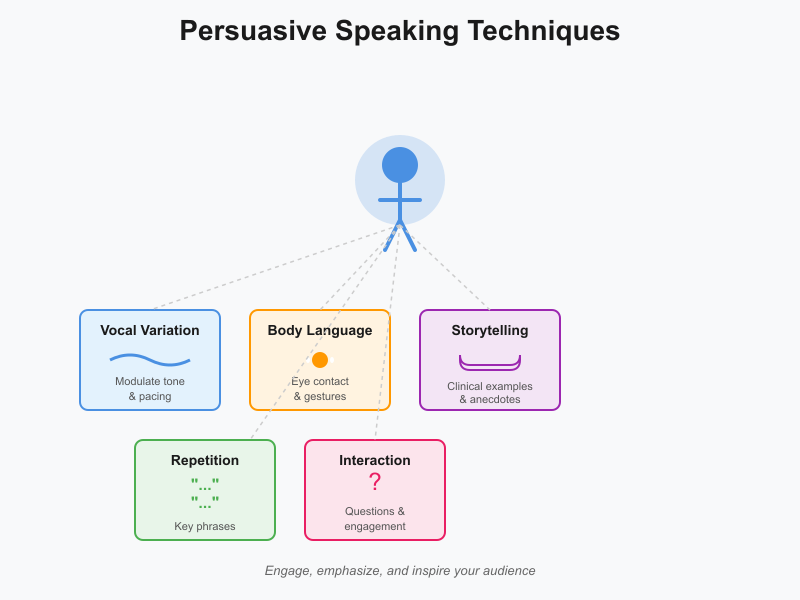
Effective public speaking is essential to deliver a persuasive message that captures attention and sustains interest. Techniques include:
- Vocal variation and pacing: Modulate your tone and adjust your speed to emphasize key points. Pausing after significant statements allows your audience to absorb critical information.
- Eye contact and body language: Maintaining eye contact conveys confidence, while purposeful gestures underscore important concepts. For instance, when emphasizing the reduction of medication errors, pointing to visual data charts can reinforce your argument.
- Storytelling and anecdotes: Sharing a clinical example, such as a patient outcome influenced by evidence-based intervention, helps the audience connect emotionally while strengthening logical arguments.
- Repetition of key phrases: Reinforcing central ideas, such as “evidence-based practice improves patient safety,” ensures that your main message resonates and is remembered.
- Audience interaction: Asking rhetorical questions or brief prompts encourages reflection and engagement, making the speech feel dynamic rather than one-sided.
Using these techniques ensures that your persuasive speech aims—to inform, convince, and motivate—are successfully achieved, and your presentation leaves a lasting impression.
How do I write a persuasive speech outline and make your speech flow logically?
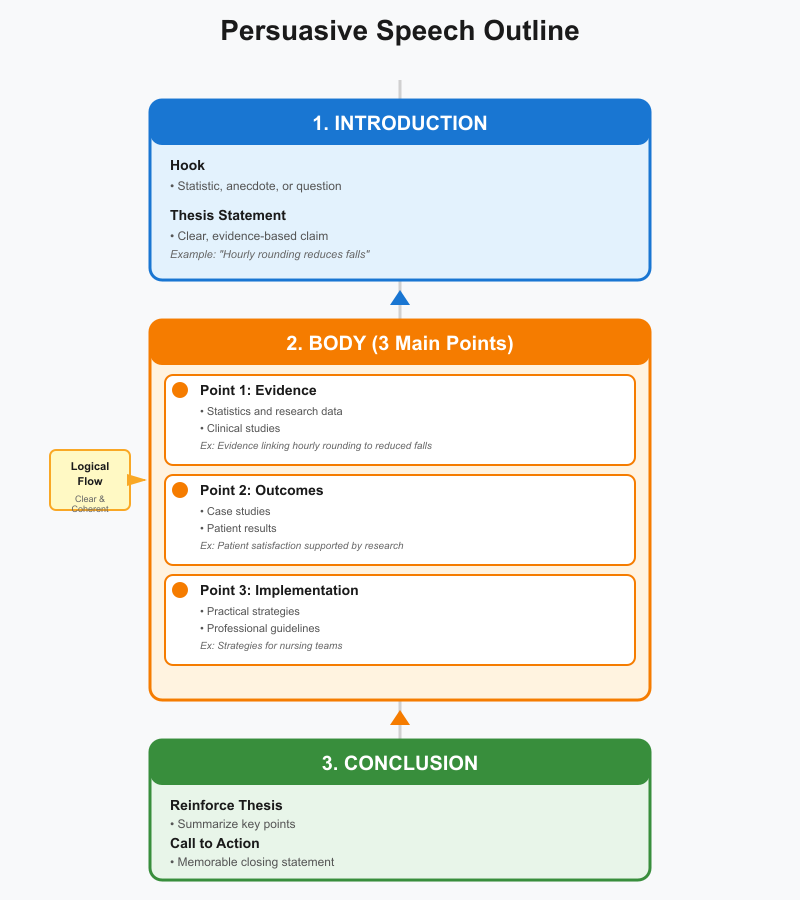
Creating a structured persuasive speech outline is critical to ensuring your arguments are clear and coherent. A strong outline typically follows three main components:
- Introduction: Start with a hook, such as a compelling clinical statistic, a patient anecdote, or a thought-provoking question. Clearly state your thesis or central claim. For instance, “Implementing hourly rounding in hospitals reduces patient falls and improves satisfaction” provides a concrete, evidence-based thesis.
- Body: Organize main points logically, each supported by credible evidence, clinical examples, or ethical reasoning. Typically, three main points are sufficient for clarity. Subpoints can include statistics, case studies, or professional guidelines that reinforce the argument. For example:
- Point 1: Evidence linking hourly rounding to reduced fall rates
- Point 2: Patient satisfaction outcomes supported by research
- Point 3: Implementation strategies for nursing teams
- Conclusion: Reinforce your thesis, summarize key points, and issue a call to action or recommendation. End with a memorable statement that encourages reflection or change, such as emphasizing the nurse’s role in improving patient safety.
A clear outline allows the speaker to deliver a persuasive speech that flows naturally, maintains audience attention, and ensures every argument is substantiated
How can I use clinical examples and evidence to strengthen my persuasive speaking?
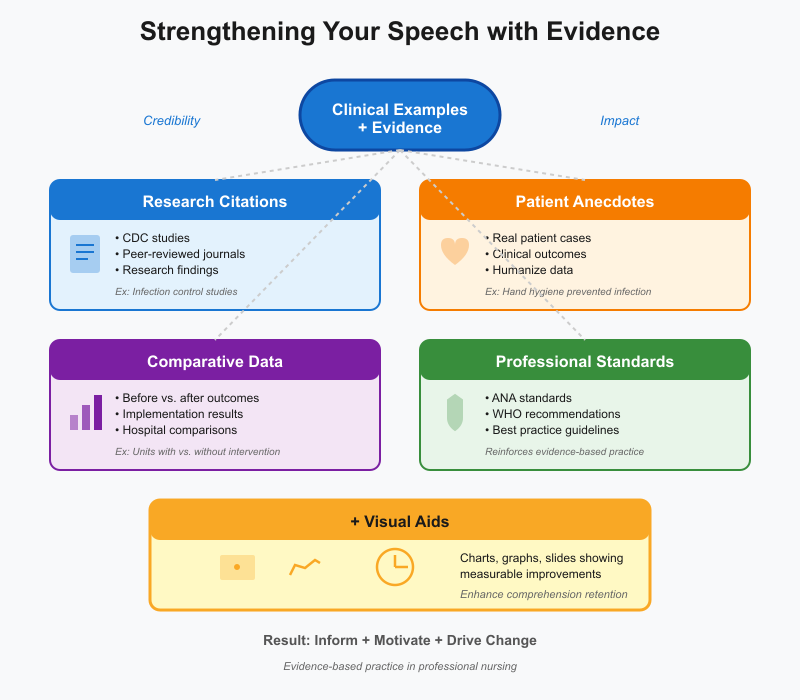
Integrating clinical examples and evidence is vital for crafting your persuasive speech with credibility and impact. In nursing education, audiences respond well to arguments rooted in patient care, professional standards, and research findings. For instance, when advocating for evidence-based infection control, citing studies from the CDC or peer-reviewed nursing journals demonstrates authority. Including anecdotes, such as a patient case where strict hand hygiene prevented a nosocomial infection, humanizes data and makes the speech relatable.
Other strategies include:
- Comparative data: Present outcomes from hospitals or units that implemented the proposed intervention versus those that did not.
- Professional guidelines: Referencing ANA standards or WHO recommendations reinforces evidence-based practice.
- Visual aids: Charts, graphs, or brief slides showing measurable improvements can reinforce verbal arguments and enhance audience comprehension.
By combining clinical examples, research, and persuasive techniques, nursing students can deliver speeches that not only inform but also motivate peers and faculty to recognize the importance of best practices, ethical decision-making, and evidence-based interventions in professional nursing.
What are some interesting persuasive speech topics, including funny persuasive speech topics, for nursing students?
Selecting interesting persuasive speech topics is a critical step for nursing students aiming to engage their audience while demonstrating knowledge and professional insight. Topics that are both informative and relatable help resonate with your audience, sustain attention, and leave a lasting impression. In nursing education, interesting topics often intersect clinical relevance, patient care, ethics, and current healthcare trends. Examples include advocating for the integration of mental health screening in routine nursing assessments, promoting patient-centered discharge planning, or arguing for the use of technology like telehealth to improve care accessibility.
Funny persuasive speech topics can also be effective if used appropriately, as they lighten the classroom atmosphere and make the speaker more relatable. However, humor must never compromise professionalism or trivialize patient care. Examples of fun persuasive speech topics suitable for nursing classes include advocating for coffee breaks to improve nurse alertness, arguing for fun scrubs to boost morale, or debating the merits of humorous patient education videos to improve adherence. The key is to select topics that are lighthearted but still tie into evidence, outcomes, or professional experiences. For instance, presenting a speech on “Using Memes to Educate Patients About Hand Hygiene” can be both humorous and informative, demonstrating creative engagement with a serious topic.
Which funny persuasive speech topics work well in a nursing class without undermining professionalism?
When integrating humor into a persuasive presentation, nursing students should focus on topics that are safe, relatable, and relevant to the clinical environment. Humor that reflects shared student or professional experiences enhances engagement without compromising credibility. Examples of appropriate topics include:
- Advocating for themed nursing uniforms to boost morale
- Using humorous patient education videos to improve adherence
- Funny reminders for hand hygiene in hospital units
- Coffee breaks as a mandatory stress-relief strategy for nurses
- Using funny mnemonics to remember medication administration steps
- Incorporating humor into simulation lab scenarios for better learning
- Lighthearted posters to remind students about patient safety
- “Pun of the day” boards to enhance nursing staff engagement
- Funny patient safety slogans to increase compliance
- Using cartoons to teach infection control procedures
- Humorous role-play exercises for difficult patient interactions
- Stress balls shaped like organs to reduce nursing anxiety
- Funny social media challenges to promote handwashing
- Nursing-themed memes in clinical education sessions
- Encouraging playful competition in patient care simulations
- Funny award ceremonies for excellent clinical skills
- Using humorous quizzes in pharmacology class
- Humor-infused orientation for new nursing students
- Lighthearted storytelling in patient communication workshops
- Using playful analogies to teach complex nursing procedures
- Funny reminders for proper PPE use
- Humor-based icebreakers for nursing team meetings
- Creating nursing-themed comic strips for patient education
- Lighthearted debates on hospital cafeteria food
- Using humorous scenarios to teach documentation accuracy
- Funny nurse wellness challenges to reduce burnout
- Using playful charts to track patient safety statistics
- Humorous skits for patient fall prevention education
- Funny examples of communication pitfalls in clinical settings
- Comedy-based workshops to practice bedside manner
- Using cartoons to explain medication side effects
- Fun competitions to encourage vital signs accuracy
- Creating humorous checklists for clinical skills practice
- Light-hearted role-play for ethical decision-making
- Funny patient simulation scenarios for stress inoculation
- Using humorous posters to promote sleep hygiene in students
- Playful nursing trivia games to reinforce learning
- Using jokes or puns to teach medical abbreviations
- Creating funny charts to demonstrate infection trends
- Using humor to reduce anxiety before exams or practicals
- Funny debates on nursing stereotypes
- Using playful patient case studies to teach documentation
- Humorous role-play to practice patient handoffs
- Lighthearted presentations on common clinical mistakes
- Using cartoons to explain lab result interpretation
- Fun ways to teach ergonomics and body mechanics
- Humor in stress management workshops for nursing students
- Funny comparisons of clinical guidelines to pop culture
- Using playful simulations to teach teamwork skills
- Humor-infused reflection exercises to improve clinical learning
What are interesting persuasive speech topics on ethics, patient advocacy, and workplace safety?
Ethics, patient advocacy, and workplace safety are perennial areas of concern in nursing practice, and speeches focused on these themes are often highly rated. Some interesting persuasive speech topics in these domains include:
Ethics
- Mandatory ethics training for all nursing students
- The role of nurses in advocating for informed consent
- Ethical dilemmas in end-of-life decision-making
- Protecting patient autonomy in critical care settings
- Ethical responsibilities of nurses in reporting errors
- Balancing patient confidentiality with family involvement
- Moral distress among nurses and its impact on care
- Ethical considerations in pain management
- The nurse’s role in advocating for vulnerable populations
- Ethical implications of rationing care in resource-limited settings
- Ethical challenges in telehealth nursing
- The importance of cultural sensitivity in ethical decision-making
- Addressing bias and discrimination in patient care
- Nurses’ ethical duty to report unsafe practices
- Ethical considerations in administering life-sustaining treatments
- Confidentiality and social media: maintaining professionalism
- Ethical responsibilities in organ donation advocacy
- Balancing patient rights with public health mandates
- The role of nurses in research ethics and human subject protection
- Navigating ethical conflicts in multi-disciplinary teams
Patient Advocacy
- Advocating for patient-centered care in hospitals
- Nurse-led advocacy for chronic disease management
- Supporting patients with mental health needs
- The role of nurses in promoting health literacy
- Patient advocacy for pain management and comfort
- Advocating for patient access to preventive services
- Supporting end-of-life choices through patient advocacy
- Nurse advocacy in promoting equitable care for minority populations
- Advocating for patient rights in long-term care facilities
- The impact of advocacy on patient satisfaction and outcomes
- Nurses as advocates for safe medication administration
- Promoting patient self-advocacy skills
- Advocacy for improved nurse-to-patient ratios
- Supporting patients during hospital discharge planning
- Advocating for family involvement in care decisions
- The role of nurses in community health advocacy
- Advocacy for patient access to mental health services
- Promoting vaccination uptake through patient education
- Nurses advocating for evidence-based practice in care plans
- Advocacy strategies to reduce healthcare disparities
Workplace Safety
- Preventing workplace violence against healthcare staff
- Promoting safe nurse staffing levels to prevent errors
- Reducing burnout through structured workplace support
- Ergonomic interventions to prevent musculoskeletal injuries
- Safe handling of infectious materials in clinical practice
- Implementing safety protocols to reduce needlestick injuries
- Addressing workplace bullying and fostering a supportive culture
- Improving communication to reduce clinical errors
- Promoting mental health support programs for nursing staff
- Safety policies for managing hazardous substances in hospitals
Conclusion
Choosing and delivering a persuasive speech as a nursing student requires thoughtful consideration of both content and presentation. Selecting a persuasive speech topic that is clinically relevant, researchable, and engaging ensures that your argument resonates with faculty, peers, and future professional audiences. Whether focusing on patient care, ethics, advocacy, or workplace safety, integrating evidence, clinical examples, and professional standards strengthens your position and demonstrates critical thinking.
In addition, mastering public speaking techniques, such as clear articulation, structured outlines, and audience engagement strategies, allows students to deliver a good persuasive speech that leaves a lasting impression. Humor, when applied carefully, can enhance relatability without compromising professionalism, while ethical and advocacy-focused topics reflect the core values of nursing practice.
Ultimately, effective persuasive speaking in nursing goes beyond fulfilling an assignment—it cultivates the ability to persuade your audience, advocate for patients, and influence positive change in healthcare settings. By combining compelling topics, evidence-based arguments, and confident delivery, nursing students can not only succeed academically but also develop skills that are essential for professional growth, leadership, and lifelong advocacy in the field of nursing.
Frequently Asked Questions
What are some good topics for persuasive speeches?
Good topics are clear, researchable, and engaging. Examples include:
- The importance of mental health screening in schools
- Advocating for healthy eating initiatives
- Implementing safe staffing ratios in hospitals
- The benefits of telehealth for chronic disease management
- Reducing single-use plastics to protect the environment
What are the persuasive speech topics for healthcare?
Healthcare-focused persuasive topics often involve patient care, policy, or ethics. Examples:
- Mandatory vaccination policies for healthcare workers
- Nurse-led interventions to reduce hospital-acquired infections
- Advocating for better mental health support for patients
- Promoting patient-centered discharge education programs
- Implementing workplace safety protocols to prevent nurse burnout
What are 5 examples of persuasive speech?
- A speech advocating for stricter hand hygiene to prevent infections
- Encouraging hospitals to adopt electronic medication administration records
- Promoting vaccination awareness in local communities
- Arguing for ergonomic interventions to prevent workplace injuries among nurses
- Advocating for patient advocacy programs in long-term care facilities
What are 5 examples of persuasive writing essay?
- An essay arguing for stricter regulations on fast-food advertising to children
- Advocating for renewable energy adoption to combat climate change
- Supporting mental health programs in college campuses
- Persuading policymakers to fund early childhood education programs
- Arguing for mandatory ethics training in nursing curricula
